Conquián and Chinchón: full rules, sample turns and beginner strategy
Conquián looks like ordinary rummy until you learn that you never draw a card into your hand. Here are the rules of both modes, a few turns played out step by step, and the mistakes every beginner makes.
An old game with one strange rule
Conquián comes from Mexico and is one of the oldest rummy games on record; many card historians call it the ancestor of the whole family, gin rummy included. It is played by two or three people with the Spanish deck and takes one hand to learn. The hard part comes later: deciding which card to throw without handing your opponent the game.
The deck and the melds
You use 40 cards: oros (coins), copas (cups), espadas (swords) and bastos (clubs), numbered 1 to 7, plus sota (10), caballo (11) and rey (12). There are no 8s or 9s, so in a run the sota follows the 7. Aces are low only: 1-2-3 is fine, rey-1-2 is not.
- Set (tercia): three or four cards of one rank, such as the 5 of coins, cups and clubs.
- Run (corrida): three or more consecutive cards of one suit, such as 6-7-sota of swords.
How to play Conquián, step by step
- Deal 10 cards to each player (8 with three players). The rest is the stock.
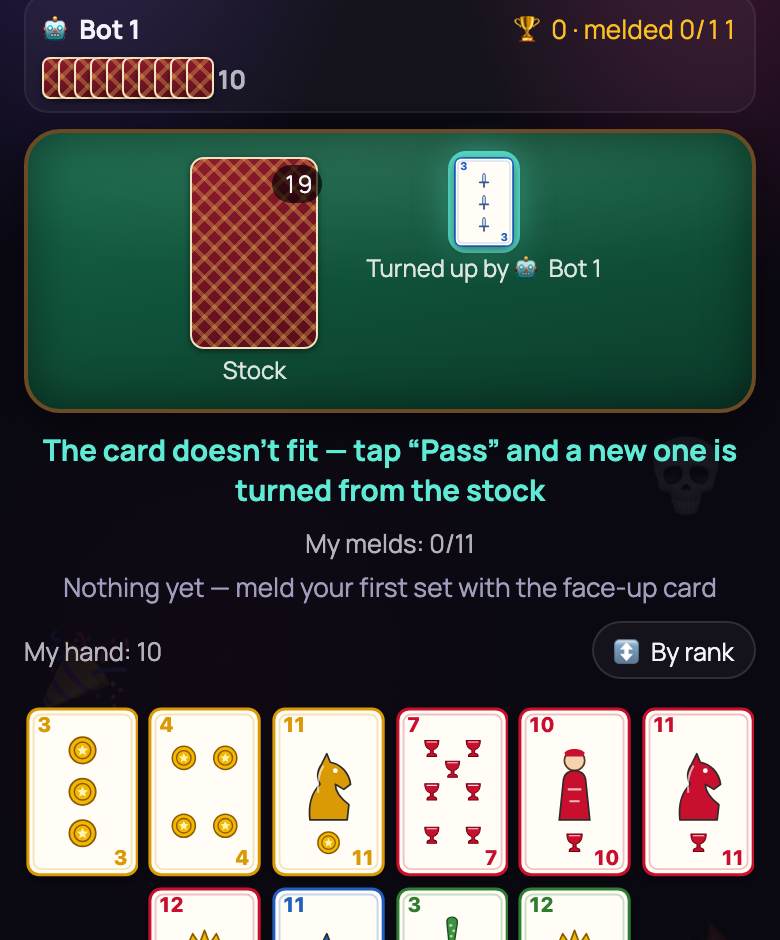
- There is always exactly one face-up card. To start, the first player turns it from the stock.
- On your turn you may take it only if you meld it at once: with cards from your hand, by adding it to your melds, or by rearranging the melds you already have on the table. It never goes into your hand.
- If you took it, discard one card from your hand. It stays face up and is offered to the next player.
- If you do not want it, pass. A card you turned yourself goes on to the next player. Anyone else's card (their discard or a card they passed) goes dead, and you turn a new card from the stock.
- You win the round with 11 cards melded (9 with three players). The last card goes down without a discard.
- If the stock runs out, the round is a draw. With three players the dead cards are reshuffled into a new stock once.
- The match goes to the first player to win 1, 3 or 5 rounds, as the host chooses.
Sample turns
1. Taking a card for a run
You hold the 4 and 5 of cups. Your opponent discards the 6 of cups. You take it, meld 4-5-6 of cups and throw the rey of clubs you had no use for. Now that rey sits face up in front of your opponent.
2. Rearranging your table
You have a set of four caballos on the table and the 7 of coins in hand. The sota of coins turns up. You take it, pull the caballo of coins out of the set and build the run 7-sota-caballo of coins. Three caballos remain as a valid set, and you have melded two more cards.
3. Passing your own card
You turn the 2 of swords and cannot use it. Passing it offers it to your opponent. If they can meld it, they take it and discard to you. If they pass, the 2 of swords is dead and they turn a fresh card.
Conquián strategy for beginners
- Discard what your opponent cannot use. Their melds are on the table. If they have the 4-5 of swords down, do not throw the 3 or the 6 of swords.
- Track the dead cards. Dead cards never come back (except one reshuffle with three players). If two 7s are dead, stop waiting for a set of 7s.
- Passing your own flip has a cost. The next player gets first refusal. If the card is even slightly useful, taking and melding it often beats letting it go to them.
- Passing someone else's card is not a wasted turn: you kill it and turn a new card, a fresh chance for you.
- Keep flexible pairs. A 5-6 of one suit waits for two cards (4 or 7). Keep the combinations with the most ways to complete.
- Use the hint button while you learn: it highlights which hand cards meld with the face-up card.
Chinchón rules
Chinchón is the rummy of Spain, Argentina and Uruguay and the second mode in our room. Here you do draw, and the scoreboard decides the match.
- 2 to 4 players, a 40- or 48-card deck (the 48 adds 8s and 9s), 7 cards each, one card starts the discard pile.
- On your turn draw from the stock or take the top discard, then discard one card.
- After discarding you may close if your unmatched cards total 5 or less.
- When someone closes, everyone adds up their unmatched cards: face value 1–9, 10 for each court card. Closing with nothing unmatched scores −10.
- Chinchón: seven consecutive cards of one suit. You win the match on the spot.
- Go over the limit (100 or 50) and you are out; the last player left wins.
- No jokers and no laying off on other players' melds. If nobody closes for a very long time, the round is replayed with no points.
A sample close
You hold 1-2-3 of coins, three reyes and the 4 of cups. You draw the 2 of clubs and discard the 4 of cups. Only the 2 of clubs is unmatched, 2 points, so you close. Everyone else counts what they could not meld.
Chinchón tips
- Close early. Waiting for a perfect −10 usually costs more than closing on 3 or 4.
- Dump court cards first. A loose rey is 10 points; a loose ace is 1.
- Watch the discard pile. What your opponent picks up tells you what they are building, so stop feeding it.
Play Conquián online with friends
Open Conquián & Chinchón, create a room and share the link. No sign-up, works on any phone, and bots (Principiante or Experto) fill empty seats. For another Spanish-deck classic, read Truco rules and strategy.
FAQ
Can you draw from the stock in Conquián?
Not into your hand. You only turn the stock card face up and take it if you can meld it right then.
How many cards do you need to meld to win?
Eleven with two players, nine with three.
What is a dead card?
Someone else's card that a player passed. It can no longer be taken, except via the single reshuffle in three-player games.
🂠 Play Conquián & Chinchón right now
Against a bot, no sign-up — your first game in a couple of minutes
More about Conquián & Chinchón · Browse all 40 games · Online party games with friends