Battleship for two: how to stop firing at random
Most Battleship games are not lost to bad luck. They are lost in the first twenty shots, fired with no system at all. Rules first, then how to hunt ships faster than the person across from you.
The rules in two minutes
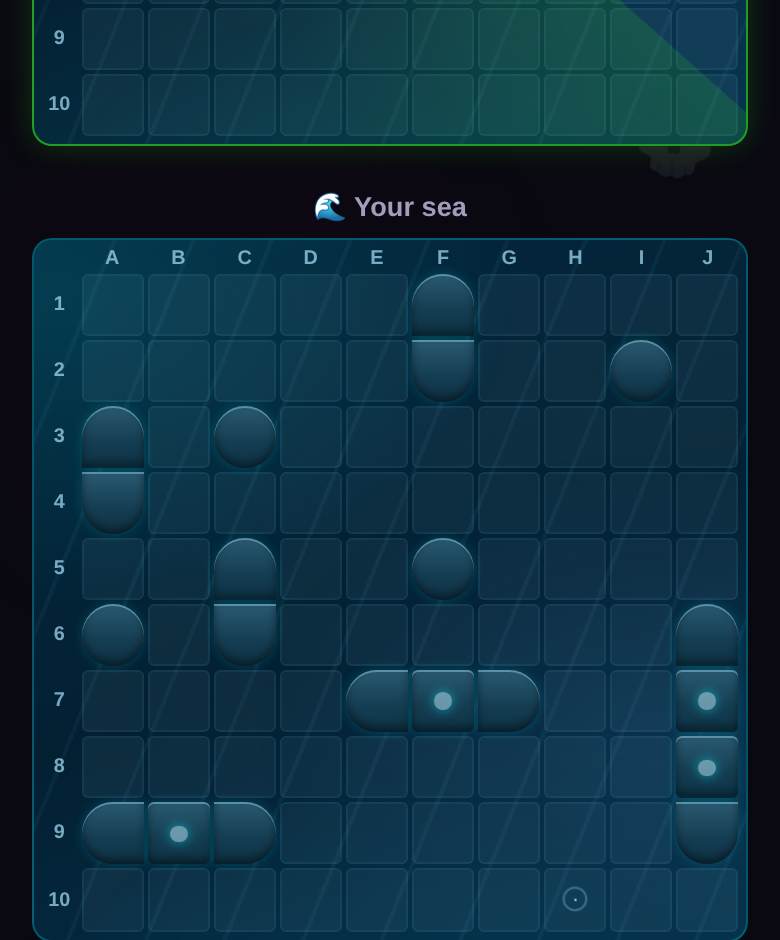
Two players. Each has a 10x10 grid — ten columns, ten rows, coordinates like E4. You never see the other grid, only your own record of where you have already fired.
Both fleets are identical: ten ships covering twenty cells.
- one 4-cell ship;
- two 3-cell ships;
- three 2-cell ships;
- four single-cell ships.
Ships sit strictly horizontally or vertically and may not touch each other — not on the sides, not at the corners. There is always at least one empty cell between any two ships. That rule matters more than it looks: a sunk ship is guaranteed to be surrounded by water, and good players cash that in immediately.
Hit, and you shoot again
A turn is one shot at one cell of the enemy grid. Miss, and the turn passes. Hit, and you mark the cell and fire again. And again, until you miss.
That single rule is where all the drama comes from. A run of six or seven hits decides the match: one player finishes off a 3-cell ship, immediately clips the next one, and the other just watches. You win by sinking all twenty enemy cells first.
Placement: what not to do
On paper, setup is half the game, and the mistakes are remarkably consistent.
- The edge feels safe and is predictable. Half of all players tuck the 4-cell ship along row 1 or row 10, and half of all players know it. Edges get swept early.
- Do not bunch the fleet together. A tight squadron in one corner looks clever right up until the first hit: after that, the water rings around your sunk ships point straight at the neighbours.
- Do not orient everything the same way. If all your big ships lie horizontally, your opponent works that out by the second hit and only ever probes sideways.
- Scatter the single-cell ships. They take the longest to find and usually decide the endgame. Put them in different quarters of the board.
In our online version the fleet is placed for you, randomly and legally. The upside is obvious: the match starts immediately, nobody argues about corners touching, and the whole game is the shooting.
Shooting: a grid beats guessing
Poking at single random cells is the slowest possible way to find a ship. The alternative: cover the board with a sparse net whose spacing equals the length of the largest remaining ship.
While the 4-cell ship is alive, fire every fourth cell along diagonal lines. Any four-in-a-row ship has to cross that net, wherever it lies. Sink it, and the biggest survivor is a 3-cell ship, so the net tightens to a spacing of three. Down to 2-cell ships and the spacing is two — the classic checkerboard, where you only ever shoot the dark squares and half the board costs you nothing.
The payoff is simple. You find the big ships early and mop up the small ones once the board is already half-mapped. Meanwhile the opponent hammering row by row is still hunting.
You got a hit. Now what
The second phase is where most shots get wasted.
- Fire at the four neighbouring cells — up, down, left, right. Diagonals are pointless; ships do not bend.
- The moment you land a second hit you know the orientation. From there, shoot only along that line, in both directions from the damaged section.
- Hit water at one end? Go to the other. The ship cannot stop in empty space.
- Sunk it? Write off the surrounding ring and go back to your net at the new spacing.
Reading your opponent
Against a human, watch where the shots land. If they keep working the edges, their own ships are probably parked there too — people search where they hide. If they are methodically chewing through the middle, you are up against someone who has read about parity.
Timing is the other tell. A long pause before a shot usually means they are recalculating after a run of misses and are about to jump to a different half of the board. Instant shot after instant shot means they are just walking a line they picked earlier.
The online version: bot, bracket, phone
On playparty, Battleship is a two-player room by link: one person creates it, the other joins by link or by a four-letter code. Neither of you signs up for anything.
No opponent right now? Add a bot. It plays hunt-and-target: random search until it connects, then it finishes the wounded ship properly before going back to hunting. Unpleasant, but honest — and a good sparring partner for practising net spacing.
More than two people around? There is a 3-to-8 player bracket with byes for odd numbers and a final table. It fits a lunch break nicely, as do the other formats in the roundup of games with friends online.
All of it works on a phone: both grids fit on screen and a shot is one tap. Lose signal in a lift and nothing breaks — reopen the page, the state comes back, and the turn still belongs to whoever had it. More on small screens and board games here: board games online on your phone.
🚢 Play Battleship right now
10 seconds from click to game. No sign-up, nothing to install.
Play free now