Backgammon online with a friend: rules, setup and first strategies
Backgammon is a race for two: each player has 15 checkers, two dice and one goal — bring every checker home and bear them all off first. A lone enemy checker can be hit and sent to the bar, and it must re-enter before anything else moves. Here are the rules step by step, first strategies and how to play a friend online.
Backgammon in one paragraph
Backgammon is one of the oldest board games still played today, and the version the whole world knows is the one we are covering here. Two players move 15 checkers each in opposite directions around a board of 24 points. Dice decide how far you move, but skill decides where: which checkers to risk, which points to block, when to attack and when to race. That mix of luck and judgment is why one game takes ten minutes and the rematch takes the rest of the evening.
The board and the starting setup
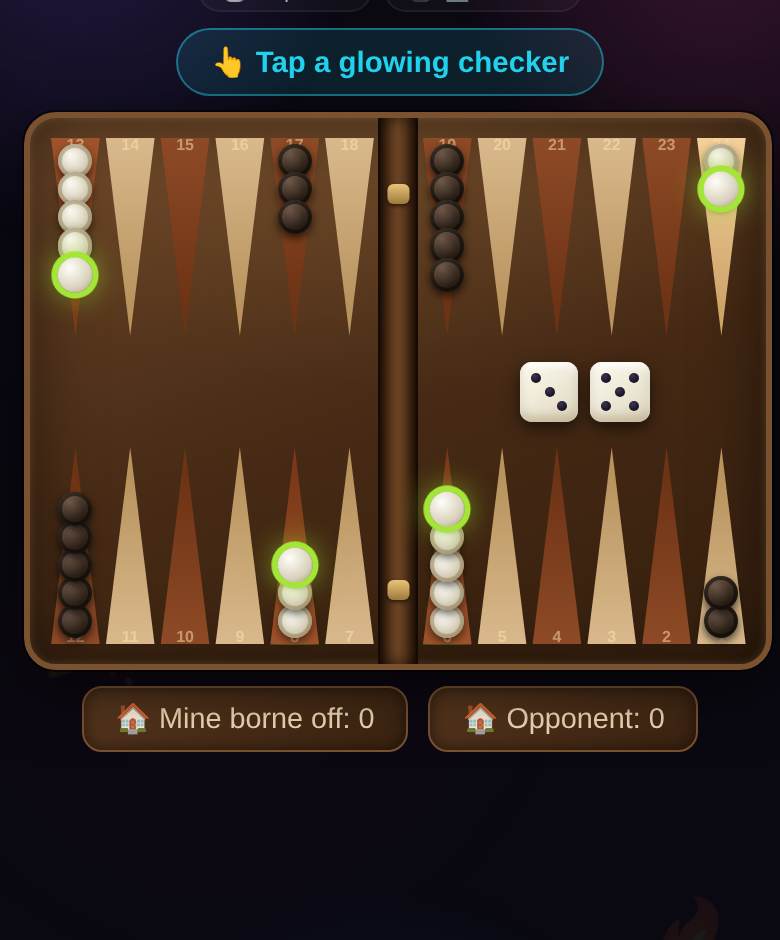
The board is split into 24 points (the long triangles) grouped into four quarters of six. Each player has 15 checkers. Points are numbered from your own home: points 1–6 are your home board, point 24 is the farthest away. Both players start with the same mirrored setup:
- 2 checkers on your 24-point, inside the opponent’s home board;
- 5 checkers on your 13-point, the midpoint;
- 3 checkers on your 8-point;
- 5 checkers on your 6-point, inside your home board.
Online, the game sets this up for you, so you only need to memorise it for a physical board.
How to move
- Roll two dice. Each number is a separate move: move two different checkers, or one checker by one number and then by the other.
- Doubles play four times: roll 4-4 and you get four moves of four points each.
- You can land on an empty point, a point with your own checkers, or a point holding exactly one opposing checker.
- A point with two or more opposing checkers is blocked — you cannot land there, not even as a stopover when one checker plays both dice.
- The two players move in opposite directions: your checkers head to your home board, theirs to theirs.
Blots, the bar and entering
A single checker on a point is a blot. Land on an opposing blot and you hit it: that checker goes to the bar, the ridge in the middle of the board. While a player has checkers on the bar, they cannot make any other move — first they must bring those checkers back in through the opponent’s home board, onto the point matching a die they rolled. If every one of those points is blocked, the turn is lost.
That is what makes backgammon so tense: one good hit sends an opposing checker back twenty-odd points, and if your home board is well built, it can sit on the bar for several turns.
Bearing off and winning
Once all 15 of your checkers are in your home board, you can start bearing off: roll a 4 and you remove a checker from the 4-point. If that point is empty and you have no checkers on higher points, a higher number can bear off a checker from your farthest occupied point. If one of your checkers is hit during the bear-off, you have to bring it all the way home before you continue.
First to bear off every checker wins. If the loser has not borne off a single checker by then, it is a gammon and the win counts double. Our casual version does not use the doubling cube, so the stakes never escalate and a game stays a friendly duel.
Beginner strategy
- Make points, do not just run. Two checkers on a point form a block the opponent cannot land on. Six blocks in a row — a prime — trap their checkers completely.
- Strong opening moves. 3-1: make your 5-point (8/5, 6/5). 6-1: make your 7-point, the bar point (13/7, 8/7). 4-2: make your 4-point (8/4, 6/4). Learn these three first.
- Count the shots. A blot six points away from an enemy checker gets hit by a direct roll 17 times out of 36 — nearly half the time. One point away, 11 out of 36. If you must leave a blot, leave it far away or where a hit costs your opponent something.
- Do not hit everything. A hit is good when the return shot does not scare you. Hitting and leaving two blots in your own home board is a classic beginner mistake.
- Know when to race. If you are well ahead in the pip count, bring your back checkers home and turn the game into a pure race.
The pip count: who is ahead in the race
To decide whether to race or hold, you need the pip count: the total distance all your checkers still have to travel to bear off. A checker on the 13-point is 13 pips; two checkers on the 24-point are 48. In the starting position each player has exactly 167. If you are 10–15 pips ahead, a straight race favors you; if you are far behind, keep your back checkers in the opponent’s home board and wait for a shot.
How to play backgammon online with a friend
- Open backgammon on playparty.live and create a room — no account, just a name.
- Send your friend the link or the 4-character code. They join from a phone or computer with nothing to install.
- Play. Each turn has a 60-second clock: enough time to think, but the game never stalls if your opponent wanders off.
Friend offline? Practice against the bot — it plays a simple game: it hits blots, makes points and heads for home, but it does not plan several moves ahead. Games count toward a backgammon Elo rating, and for groups of three or more there is a tournament mode for 3–8 players: the platform builds the bracket, and half an hour later your group has an official champion. More classics in our post on board games on your phone.
FAQ
Is there a doubling cube?
Not in our casual version. Gammons still count double, but stakes never escalate beyond that.
Are the dice fair?
Dice are rolled on the server with a cryptographically secure random number generator, not in a player’s browser, so nobody can tamper with them on their side.
What happens if all my entry points are blocked?
You lose the turn and roll again next time. That is exactly why building your own home board is so powerful.
Can I play on my phone?
Yes. The board scales to the screen and moves are made by tapping. Looking for another two-player classic? Try chess with a friend online.
🎲 Play Backgammon right now
Against a bot, no sign-up — your first game in a couple of minutes
More about Backgammon · Browse all 34 games · Online party games with friends