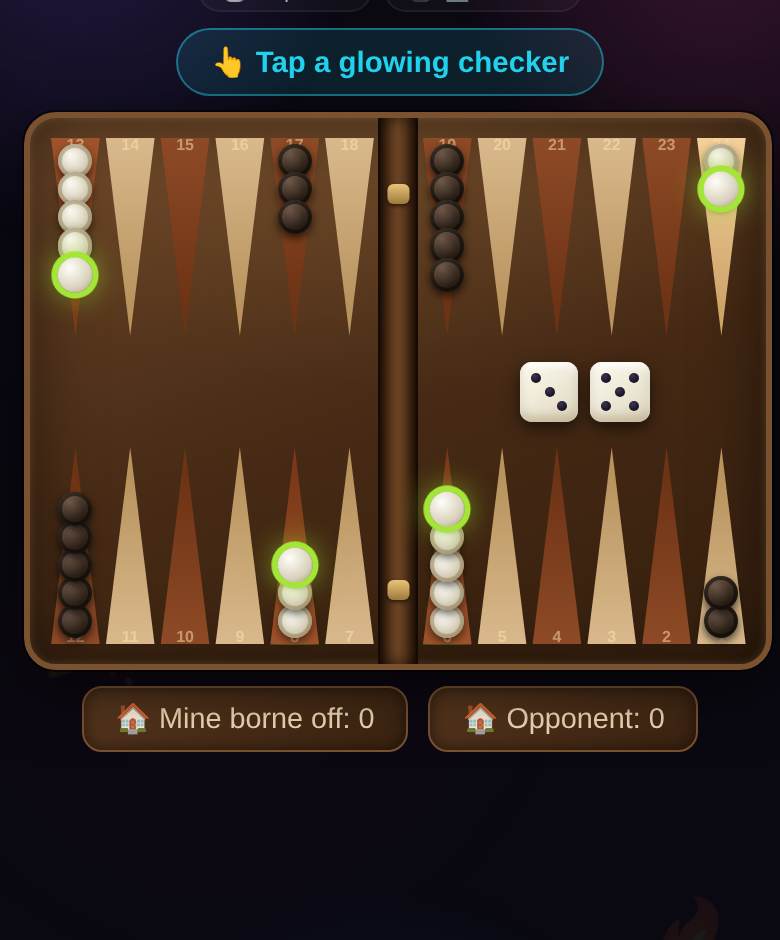
The game, and the version we play
Backgammon comes from the ancient “tables” family played from Persia to Rome. Its modern American form took shape in 1920s New York clubs, where the doubling cube was added, and it boomed again in the 1970s. The appeal never changed: the dice decide how far you move, you decide where — which checker to risk, which point to block, when to run.
Ours is classic backgammon with hitting, the bar and bearing off, played as single games without the cube.
Backgammon rules, as played here
- Each side has 15 checkers in the standard setup: 2 on the 24-point, 5 on the 13-point, 3 on the 8-point and 5 on the 6-point. The board sets itself up.
- Dice roll automatically at the start of your turn. Each number moves one checker; doubles are played four times.
- You may land on an empty point, on your own checkers, or on a point with a single opposing checker — that is a hit, and the checker goes to the bar.
- A point with two or more opposing checkers is blocked.
- With a checker on the bar you must enter it in your opponent’s home board before any other move. If every entry point is blocked, your turn passes.
- Once all 15 checkers are in your home board (points 1–6), you bear off: with the exact number, or with a higher number from your farthest checker.
- First to bear off all 15 wins 1 point. If the loser has not borne off a single checker, it is a gammon worth 2 points.
Two things US players may miss: there is no doubling cube, and no backgammon triple — any gammon counts 2, even with a checker stuck on the bar. The board calls a gammon “mars”, the name used in Russia and the Middle East. White moves first in game one, and colors swap every rematch. For the full rules with examples, see our backgammon rules for beginners.
How to play backgammon online with a friend
- Pick Backgammon and create a room: just a nickname, no account.
- Send your friend the link or the 4-character room code (letters and digits). They join from a phone or laptop with a nickname.
- No one around? The host adds a bot. Rooms hold two players.
- Moving takes two taps: a glowing checker, then a blinking point. Red means a hit.
- Every checker move has a 60-second clock. If it runs out, the game makes a move for you, so a match never stalls.
- After a game the host hits Rematch: colors swap and the room keeps a running score, perfect for a first-to-3 or first-to-5 match.
Every game counts toward a backgammon Elo rating that starts at 1000. Games against the bot move your rating at half speed, so nobody can farm it. Top players appear on the leaderboard in leagues from Bronze to Legend. Three or more people? Run a tournament for 3–8 players: a bracket of duels in one room.
What to expect from the bot
The bot is quick and direct: it bears off when it can, hits blots, makes points and pushes checkers home, avoiding loose checkers outside its home board. It does not plan primes or calculate deep — a good sparring partner for beginners, not an expert.
Five tips that win more games
- Make points, not scatter. Two checkers on a point block your opponent. Your 5-point and 7-point (the bar point) matter most early: play 3-1 as 8/5 6/5 and 6-1 as 13/7 8/7.
- Know your shot odds. A blot 6 pips from an enemy checker is hit by 17 of 36 rolls; at 7 pips only 6 rolls hit. If you must leave a blot, leave it far away.
- You choose the order of the dice. The game will not reorder them for you: play the awkward number first and the other may have nowhere to go and be lost.
- Build before you hit. The more closed points in your home board, the longer a hit checker stays on the bar.
- Ahead in the race? Run. Count pips (the total distance left; each side starts at 167). If you lead, break contact and race home.
No dice wanted? Try chess or checkers; Ludo is a dice race for up to four.