Your own bracket, no spreadsheet required
Americans fill out brackets every March, but running one for your own group is a chore: someone sketches it on a whiteboard, pairings get mixed up, and seven players means an argument over who gets the bye. Single elimination itself is simple — lose once and you are out — it is the bookkeeping that kills it.
Here the server keeps the bracket. Gather 3 to 8 people, pick one head-to-head game, and the first match starts within a minute. Pairs play one at a time in the same room while everyone else watches the board live and heckles. That is the real difference from splitting into pairs: the tournament becomes one shared show for the office, the dorm or the family group chat.
How the bracket works
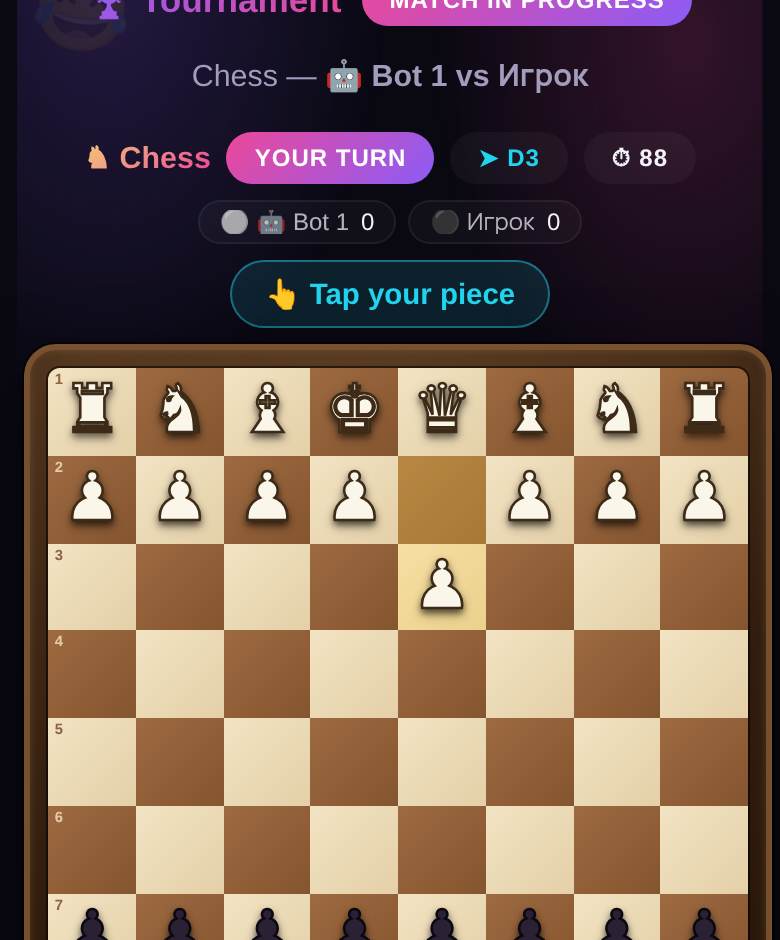
- The host picks the bracket game: chess, checkers, backgammon, battleship, tic-tac-toe or durak. The whole tournament uses that one game; chess is the default.
- The draw is random. The bracket has 4 slots for 3–4 players and 8 slots for 5–8.
- If you are not exactly 4 or 8, the empty slots become byes: those players skip round one and go straight to round two. There is never an empty “nobody vs nobody” pair.
- Matches run strictly one at a time, with a 6-second pause between them so everyone can look at the updated bracket.
- The winner advances, the loser is out. If a game ends in a draw (stalemate in chess, a drawn checkers game), a coin flip decides who goes through.
- After the final you get standings: champion, runner-up, then everyone else by the round they went out. Points: +1 per match won, +3 bonus for the champion.
Each duel uses the same rules as the standalone game: Russian-style checkers on 8×8 with forced captures and flying kings, classic backgammon without the doubling cube, battleship on a 10×10 grid, and two-player durak, the Russian card game with a 36-card deck. Tic-tac-toe is played as a first-to-five series, and drawn rounds do not count.
Setting it up for your group
- Open Tournament, type a nickname and hit “Create New Game.”
- Drop the link in Slack or the group text, or read out the room code — four characters, letters and digits.
- People join from a phone or laptop with just a nickname. No account, no app. The room holds up to 8.
- Short on players? The host adds bots in the lobby. A bot plays its own match, and a bot-vs-bot pairing is played out too.
- The host picks the game and hits “Start Game.” Nobody can join once it is running, so get everyone in first.
Every move has a limit: 90 seconds in chess, 60 in checkers and backgammon, 45 in battleship and durak, 30 in tic-tac-toe. If it runs out, the server moves for you, so a bracket never stalls because someone stepped away. After the final, the host taps “New tournament” for a fresh draw with the same lineup.
A private tournament with friends does not touch anyone’s Elo rating. The Tournaments page (playparty.live/tournaments) shows how many brackets are live right now, an archive of finished tournaments with their podiums, and open scheduled tournaments: sign up in advance, play real opponents only, earn season points, and the champion gets stars ⭐ and a spot in the Hall of Fame.
Picking a game for the occasion
- Lunch break. Tic-tac-toe or battleship. Games are short, and an 8-player bracket is seven matches back to back.
- Chess night. Chess with eight players is also seven games, but each can take half an hour. Great for an evening, not for a lunch hour.
- Mixed skill levels. Backgammon has dice, so a newcomer can knock out the office shark. That keeps the bracket from being a foregone conclusion.
- Family game night. Checkers is familiar to everyone, though forced captures and flying kings surprise people raised on American rules. Do a practice game first.
- Six or seven players. Byes are handed out at random. If that feels unfair, fill up to eight with bots so everyone plays round one.
For more ideas see office party games, and for one-on-one games read playing chess with a friend online.