How to actually get that chess game with your friend going
Getting a game against a stranger takes five seconds anywhere. Getting a game against Dave, who has been meaning to play since March, is a different problem entirely. Here is how to remove everything standing in the way.
Why the game never happens
You know the pattern. You agree to play, you send your friend a link to one of the big chess sites, and he lands on a signup form, an email confirmation, an avatar picker and a suggestion to take a rating placement test. He says "yeah, I'll register tonight." Tonight never arrives.
Chess is not the obstacle. Everything in front of chess is. Both people need accounts, the interface assumes you already live on the site, and the default button matches you with a stranger — playing a specific friend is a separate feature you have to go find. For one Wednesday-evening game, that is a lot of overhead.
Getting your friend in: four steps
The version that actually works is short: one link, one click, a board. Here is how it goes in Chess.
- Open the game and hit "Create room." No account, nobody asks for your email.
- Copy the link and drop it in whatever chat you already use — WhatsApp, Telegram, the work Slack channel.
- Your friend opens the link and lands straight at the board. If he is on a phone and the link got buried, there is a four-letter room code you can read out loud.
- Colours sort themselves out: whoever created the room plays White, and a rematch swaps the sides. Ten seconds between "let's play" and the first move.
When your friend barely knows the rules
The usual excuse is "I don't really play, it'll be boring for you." What people actually fear is not losing — it is looking silly: making an illegal move, freezing for a full minute, hearing a sigh on the other end of the call.
Half of that goes away on its own. Pick up a piece and the board highlights every legal move it has, castling and en passant included — and en passant catches out plenty of people who "used to play a bit." An illegal move simply cannot be made, so there is nothing to be embarrassed about. There is an Elo rating — chess is a duel game, so it recalculates after each match and feeds the leagues from bronze up to legend — but everyone starts at 1000, it lives on a separate rating page, and nobody has to go look at it. The game itself is published nowhere: the only witnesses were the two of you.
One more thing that helps: give the beginner White by letting him create the room, and keep your commentary to yourself until asked. A post-game review is useful. A running commentary turns the game into an exam.
Five tips so you survive the opening
If you are the friend who "used to play a bit," this is the short version that keeps you alive past move ten.
- Develop pieces, not pawns. The first few moves are for knights and bishops heading toward the centre. Pawn adventures on the edge develop nothing.
- Keep the queen home early. Bring her out and your opponent attacks her with minor pieces, gaining time while you run. Knights and bishops first.
- Castle by about move ten. A king stuck in the centre with the lines opening up is the single most common reason beginners get mated out of nowhere.
- Count the trade before you take. How many of your pieces hit that square, how many of theirs? One extra defender is the whole story.
- Watch for forks. Knights jump in an L and love catching a king and a queen at once. After every enemy move, ask one question: what is attacked now?
Play a series, not a game
A single game is a bad format. Someone hangs a piece on move fifteen, the whole thing is over in eight minutes, and what is left is mild irritation rather than fun. Agree on a series up front — first to three, or simply "until we get bored," swapping colours every game.
A series shows different things. Your opponent starts recognising your habits and you start recognising his; game three plays nothing like game one. And losing stops being a verdict, because there are two more coming.
More than two people want in
At an office or a house party the problem inverts: five people want to play and a board seats two. That is what the 3-to-8 player bracket is for. One person sets up the room, the system pairs everyone, hands out byes when the numbers are odd, and moves winners along until there is a final table. Nobody keeps the pairings on a napkin.
A six-person bracket fits inside a lunch break, roughly. If it lands well, the same bracket runs over checkers and battleship too — more on rounding up a group online in the guide to games with friends.
It works on a phone
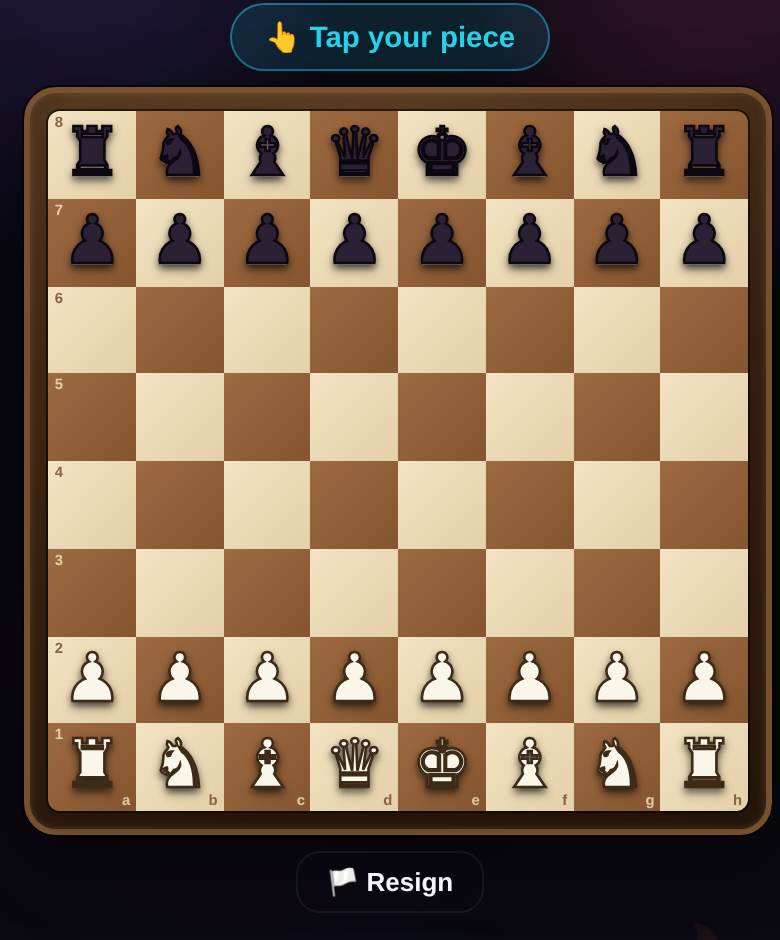
Nobody installs an app for one game, so this opens in a phone browser like any other page. The board scales to the screen and pieces move by tapping: tap the piece, tap the square. Harder to fumble than dragging with a thumb.
Tunnels, lifts and dead spots happen; when the connection comes back the page pulls the position again and the move is still with whoever had it. For how board games behave on a small screen generally, there is a separate write-up: board games online on your phone.
So "I'm on my phone, it's awkward" is off the table as well. All that is left is texting your friend.
♟️ Play Chess right now
10 seconds from click to game. No sign-up, nothing to install.
Play free now