A picture-card guessing game for game night
Associations is a storytelling card game played with dreamlike pictures instead of words. The winner isn’t the smartest player but the one whose hints land with some of the table, never all of it. The genre started with Dixit, a French board game from 2008 that won Germany’s Spiel des Jahres in 2010. Want to play that kind of game online with friends for free? This browser version has its own art and nothing to install.
It takes a minute to teach, needs no trivia or fast reflexes, and every reveal starts a conversation (“why did that remind you of your aunt?”). It suits a holiday get-together as well as a remote game night — see our holiday party games plan.
The rules in six steps
- Everyone gets 6 cards. The first storyteller is random; then the role rotates.
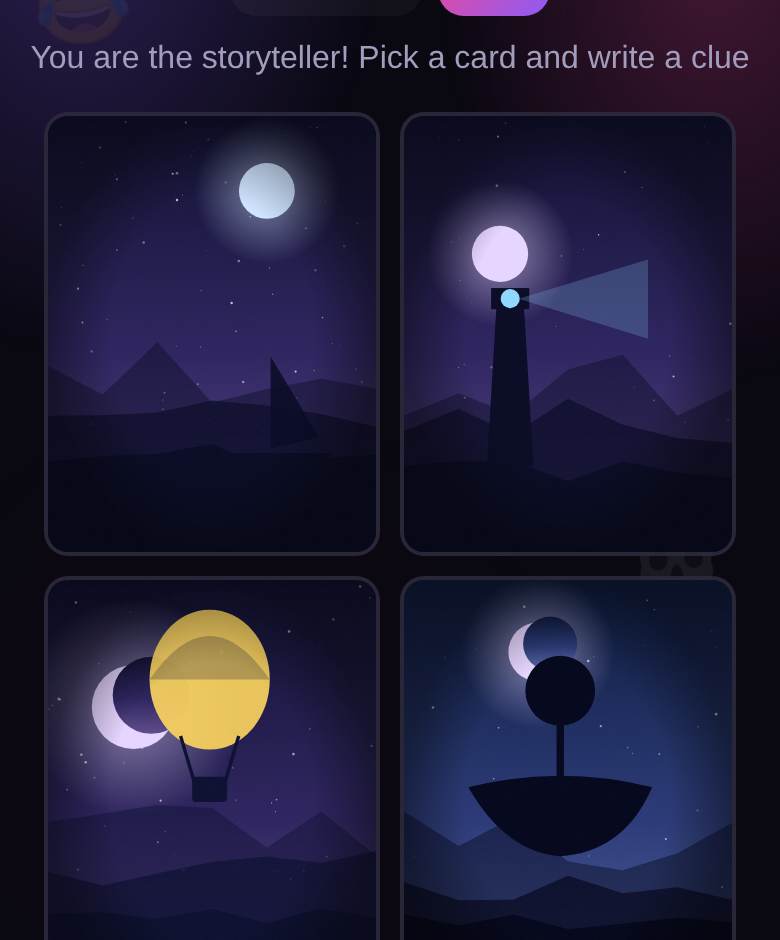
- The storyteller picks a card and types a clue for it — a word, a phrase, a song lyric, up to 100 characters — within 60 seconds.
- Everyone else has 45 seconds to play a card from their hand that also fits the clue.
- The cards are shuffled and shown without names. All but the storyteller get 40 seconds to vote for the original; you can’t vote for your own.
- The reveal shows who played what and who voted where. Scoring is automatic and hands refill to 6.
- A game has a set number of rounds: 6 with three players, 8 with four, 10 with five, 12 with six or more. Top score wins.
| What happened | Storyteller | Everyone else |
|---|---|---|
| Some found the card, but not all | +3 | +3 to each correct guesser |
| Everyone found it | 0 | +2 each |
| Nobody found it | 0 | +2 each |
| Players voted for the card you slipped in | — | +1 per vote |
So an obvious clue earns the storyteller exactly as much as an impossible one: zero. Worked examples are in our guide to the rules and scoring.
Playing online with friends
Create a room to get a link and a 4-character code (letters and numbers). Drop the link in the group chat or read the code out on a call; friends open it on a phone or laptop, type a nickname and they’re in. No accounts, no app store.
- Players. Three minimum, four to six is the sweet spot. The host can add bots, even mid-game, but bots play and vote at random — they fill a seat, not the fun.
- Timers. A storyteller who stays silent for a minute loses the turn, and that round still counts. Miss the card or vote deadline and you get a random pick.
- Rematch. One tap from the host resets scores and keeps the group together. The host can also end a game early; the current leader wins.
- Big screen. Open playparty.live/tv on a smart TV and enter the room code to show the storyteller, the clue, the voting cards, the reveal and the final podium. Hands never appear there.
Decks, settings and house rules
The only lobby setting is the deck, picked by the host before the start; each option previews its first card. Every deck has 40 illustrations, and right now all of them are free — a paid deck, if one is ever added, shows a lock 🔒. Timers and round counts are fixed, so a game runs about 15–30 minutes.
Scoring follows the classic boxed game: a storyteller who misses just scores zero, and points only go up. There’s no “first to 30” finish — with three to six players everyone tells exactly twice. House rules like “no proper names” are up to your group; the game only enforces the 100-character limit.
Strategy tips
- Aim for part of the table. With five players, one to three of the four guessers finding your card is ideal. A clue everyone gets scores nothing.
- Use shared history. An inside joke from the group chat or a lyric only the music nerds know splits the room the right way.
- Make decoys count. Each vote on your card is +1, so play one that matches the clue’s words more literally than the storyteller’s card probably does.
- Card first, words second. A minute goes fast, and clues of one to four words usually beat long sentences.
Liked fooling people with decoys? Bluff Club does it with made-up facts. For team word associations, try Cipher Words.