The rules, the scoring, and the paradox in the middle of it
A game where the winner isn't the cleverest player but the one exactly one other person understands. Here are the rules, the scoring, and how to stop writing clues nobody votes for.
The rules in two minutes
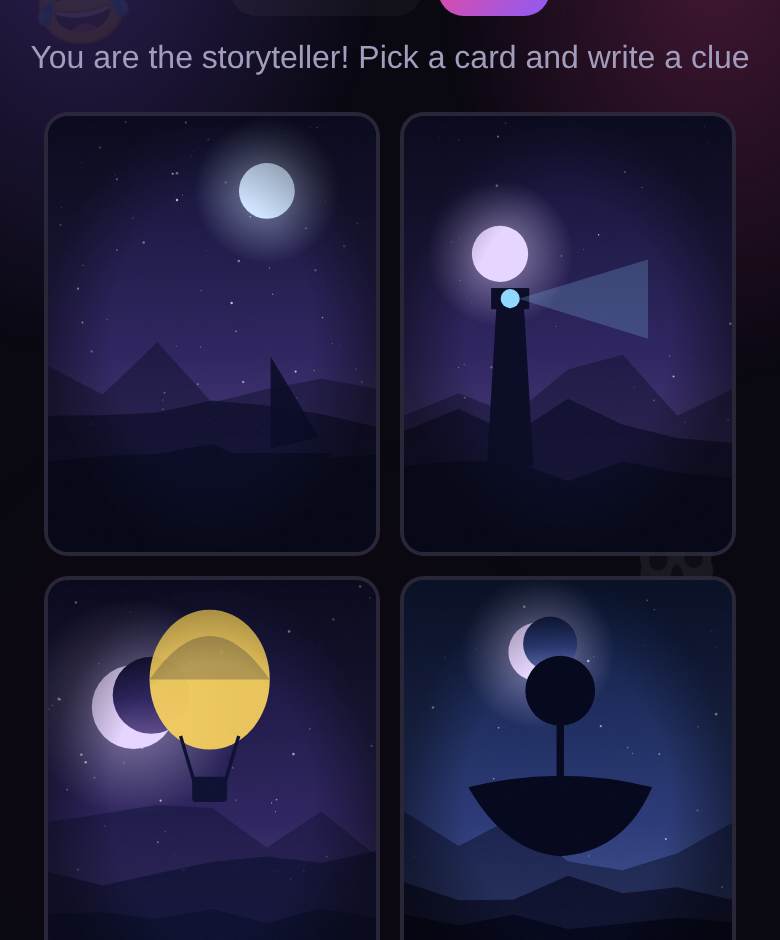
Everyone holds a few cards with surreal illustrations: a whale in a suitcase, a staircase to nowhere, a person with a clock for a head. One player is the storyteller. They pick a card from their hand, show it to nobody, and say a clue out loud — a word, a phrase, a song lyric, a sound, anything.
Everyone else then finds a card in their own hand that could also fit that clue and plays it face down. The cards are shuffled, laid out in a row, and everyone except the storyteller votes for the one they think was the original. Cards flip, points are counted, the storyteller role passes on.
A game with 4–6 players takes 20–30 minutes. Three is the minimum: with fewer, there is nothing to vote between.
How scoring works
The scoring is what turns this into a game instead of a poetry contest. The classic scheme, which we follow:
- If some but not all players find the storyteller's card, the storyteller scores 3 and every correct guesser scores 3.
- If everyone or nobody finds it, the storyteller scores nothing and every other player scores 2.
- On top of that, each player scores 1 for every vote their own decoy card collected.
Every bit of tactics falls out of those three lines. Being understood by everyone pays zero. Being understood by no one pays zero. The perfect clue lands with one or two people out of five.
The paradox: too obvious and too clever both lose
Say “the sea” for a card with a wave and everyone gets it instantly — zero points and an awkward silence. Say “epistemic rupture” for a card with a moon and nobody gets it — the same zero, just with more syllables. A good clue is the one where half the table frowns and one person suddenly goes “oh, right.”
The practical consequence: the best clues come from the group's shared context, not from what's drawn on the card. “That thing on Thursday.” “My roommate's cat.” “Where we never made it to.” To a stranger those are noise; to your people they are a direct hit. It's also why the same deck plays completely differently with coworkers than with friends of ten years.
How to invent clues people actually vote for
Do not describe the picture. That is mistake number one: a bird card gets “bird,” a door card gets “exit.” Use a different layer instead.
- A song lyric. Half the table knows the track and half doesn't — that split is exactly what you want.
- A sound. “Creak.” “Shhh.” “An alarm at 7 a.m.” Sounds are almost impossible to attach to someone else's card by accident.
- An emotion or a state. “Monday.” “Hour three of the meeting.” “Right after an exam.” Works better than nouns.
- A private fact. “That thing on Thursday.” “My first bike.” Only for groups who go back a while.
- A verb instead of an object. “Running away.” “Waiting.” “Pretending.” Shifts attention from the thing to the action and confuses the decoy players.
Keep it short, too. A long clue with three specific details almost always points at exactly one card — and that is the zero-point ending again.
Beginner mistakes
- Playing a decoy that fits the clue too perfectly. You collect votes, but so does the storyteller — the opposite of what you wanted.
- Voting for the prettiest illustration. Beauty has no correlation with the clue, and the table picks up on that habit within two rounds.
- Explaining your clue for more than ten seconds after the reveal. Nothing kills the pace faster.
- Playing with exactly three and wondering why it feels thin. The vote math is cramped at three; four and up is noticeably better.
Playing it online
Our Associations runs on exactly this structure: three decks of abstract art with different moods, 3 players and up, join by link or a four-letter code, no signup. The storyteller types their clue, everyone else picks a card with a tap, and voting and scoring are automatic — no arguments about who owed whom two points.
Short on people? Add bots. They play decoys and vote, so two humans and two bots is already a real game. If someone drops out on the way, the room holds their seat and restores their hand when they come back — worth a lot when half the group is playing from a phone.
It pairs beautifully with a video call: keep cameras on during the vote, because half the fun lives in people's faces. We collected formats like that in the roundup of games for video calls, and there's a broader tour of group modes in the guide to playing with friends online. If a round of abstraction leaves the group craving something blunter, Meme Party is right there, and if they'd rather draw than guess, try Pictioner.
🖼️ Play Associations right now
10 seconds from click to game. No sign-up, nothing to install.
Play free now