How to play charades: rules, secret signals, 50 ideas and playing online
Charades is the party game where you act out a word or title without making a sound while everyone else guesses. Below: rules for a casual circle and for teams, the hand signals that save half your turn, 50 charades ideas from easy to grown-up funny, and how to play on a video call — in Explain It! only the actor sees the word on their phone, and the game keeps time and score.
How to play charades: the basic rules
Classic charades needs no board and no cards — just people, a few ideas on slips of paper and a willingness to look silly. Here is how a round works:
- One player is the actor. They secretly get a word or title: drawn from a hat, whispered by the other team, or shown on a phone.
- They act it out using only gestures, facial expressions and movement. No talking, no mouthing words, no sound effects and no spelling letters with your fingers.
- Everyone else shouts out guesses. The actor nods when someone is getting warm and shakes their head when they are off.
- When someone says the exact word or title, the round ends.
- If nobody gets it within the time limit — usually two or three minutes — the actor reveals it and play moves on.
In the casual version there are no points: whoever guesses correctly acts next. It works well for four to eight people around a table. With a bigger crowd, or a competitive one, switch to team charades.
Team charades: team size, timing and scoring
Split into two to four teams and take turns. One player acts, only their teammates guess, and the other team keeps quiet — no helpful eyebrows. The three formats people actually play:
| Format | How it works | Time | Scoring |
|---|---|---|---|
| One title per turn | The other team writes the clue for the actor | 1–3 minutes | 1 point per correct guess |
| Speed round | The actor runs through as many cards as possible | 30–90 seconds | +1 per word, −1 per skip |
| Free-for-all (kids) | No teams: whoever guesses acts next | No limit or 2 minutes | No points |
How many per team? Two to five is the sweet spot. Past six, half the team stops guessing and just watches. For 10–16 people, run three or four teams of three or four and cut turns to 30–60 seconds, so nobody waits ten minutes for their go.
Rotate the actor within each team so everyone gets a turn in the spotlight. Play to a target score, say 25 points, or a fixed number of rounds — but make sure every team gets the same number of turns before you crown a winner.
Charades hand signals everyone should know
Seasoned players use a shared set of signals. They are not cheating — they are a common language that saves half your turn. Agree on them before you start:
- Category. Crank an old film camera for a movie, open your palms like a book for a book, sing into a fist for a song, draw a rectangle in the air for a TV show, pull a rope for a play.
- Number of words. Hold up that many fingers, then hold up fingers again to show which word you are acting.
- Syllables. Lay fingers on your forearm for the number of syllables, then tap the one you are acting.
- Sounds like. Tug your earlobe, then act a rhyme: for “bear”, “chair” may be quicker.
- Small word. Hold thumb and forefinger close together for “a”, “the”, “of”.
- On the nose. Point at your nose when someone says it exactly.
- Getting warm. Beckon with both hands: keep going, you are close.
- Longer or shorter. Stretch an imaginary piece of gum for a longer form (“run” → “running”), squash it for shorter.
- Past tense. Wave a hand back over your shoulder.
- Whole thing. Sweep your arms in a big circle: now I am acting the meaning of the whole title.
Banned almost everywhere: talking, mouthing, spelling letters in the air, pointing at the object in the room (if the word is “lamp”, you cannot just point at the lamp) and helping the other team. Pointing at yourself or at body parts — “eye”, “nose”, “me” — is normally fair game.
Charades ideas: easy, medium and hard words
A good charades word is one you can turn into an action. Objects and verbs are easiest; abstract ideas are hardest, and they produce the best moments of the night.
- Easy (kids and warm-up): dog, airplane, brushing teeth, ice cream, swimming, elephant, umbrella, bicycle, butterfly, guitar.
- Medium: vacuum cleaner, fishing, selfie, parachute, wedding, snowman, alarm clock, yoga, surfing, dentist.
- Hard: déjà vu, inspiration, insomnia, echo, sarcasm, procrastination, nostalgia, jealousy, gravity, goosebumps.
For a mixed group, aim for roughly half easy, a third medium and a couple of hard ones for dessert. The first turns need quick wins — that is what gets the shy guests off the sofa.
Themed charades: movies, songs, sayings and grown-up funny
Once single words feel easy, move to full titles. This is where the category and word-count signals earn their keep.
- Movies: Titanic, Jurassic Park, The Lion King, Home Alone, Jaws, Back to the Future.
- Songs: Happy Birthday, Jingle Bells, Twinkle Twinkle Little Star, Bohemian Rhapsody, Let It Go.
- Sayings: It’s raining cats and dogs, Break a leg, The early bird catches the worm, Piece of cake.
- Jobs: firefighter, lifeguard, astronaut, beekeeper, DJ.
- Funny for adults: assembling flat-pack furniture, stuck in traffic, Monday morning, untangling holiday lights, looking for the phone you are holding, parallel parking, the group chat that never sleeps, forgetting someone’s name mid-hug.
How to play charades online with friends
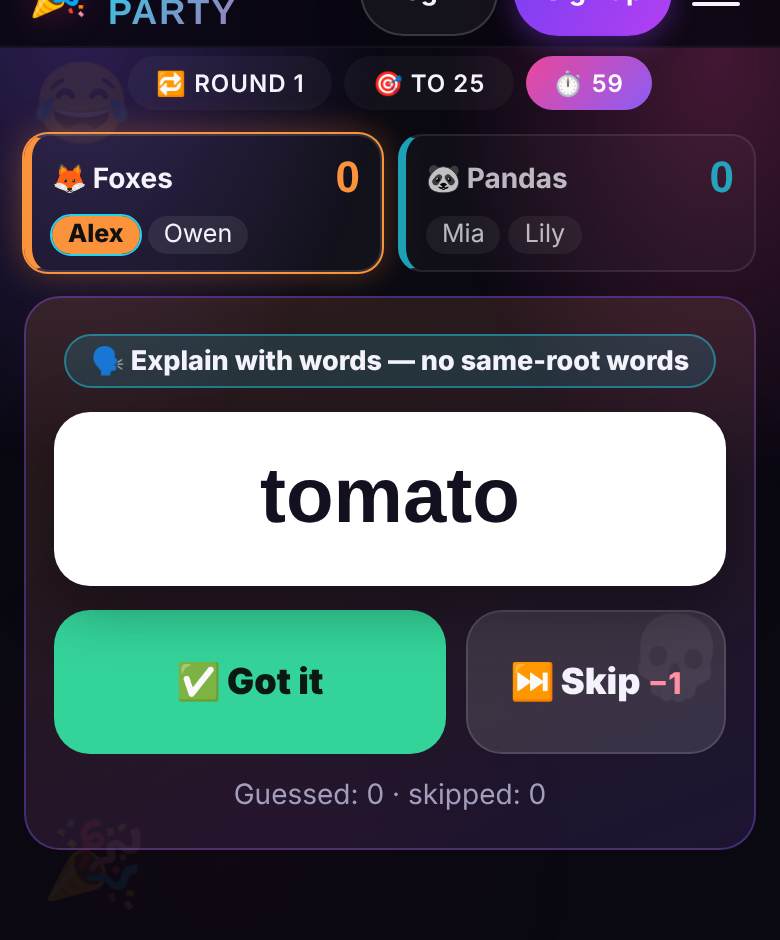
The hard part of remote charades is logistics: someone has to slip the word to the actor privately, watch the clock and keep score. In Explain It! the phones do all three:
- The host creates an Explain It! room and drops the link or the four-character code into the group chat. No app, no accounts.
- Everyone joins from their phone and picks a team, or the host taps “Shuffle”. It takes 4 to 16 players in 2–4 teams, at least two per team.
- Under “How to explain”, choose “🙌 Gestures” — that is charades: the actor’s screen literally says “no talking!”. “🎲 Mixed” randomly assigns words or gestures to each card.
- Turns last 30, 60 or 90 seconds; you win at 15, 25 or 40 points, or after 2, 3 or 5 rounds. Word difficulty: easy, medium, hard or all of them.
- The actor taps “▶ Go!”, sees the word on their own phone only and acts it out on camera or in front of the team. Guessed? “✅ Got it” and the next word appears. Stuck? “⏭ Skip” costs a point (the host can switch the penalty off).
- When time runs out, the actor gets 20 seconds to review: undo an accidental tap and count a word guessed right on the buzzer. Then the next team is up.
On a video call, run the call on a laptop or tablet and the game room on your phone. The actor should step back from the camera so their whole upper body is in frame. If you are all in one living room, open playparty.live/tv on the TV and enter the code: it shows a big timer, the scores and whose turn it is — but never the word.
To be upfront about the deck: there are roughly 350 family-friendly words per language — objects, animals, places, jobs and ideas across three difficulty levels. You cannot add your own titles, so play the movie and song rounds from the lists above on paper, and use Explain It! for the fast team turns. There are no bots: acting and guessing take real people.
Charades vs. Hat, Fishbowl and Alias
These games get mixed up all the time. In charades you act in silence. In Alias-style games you describe the word out loud without saying it or a word with the same root. Fishbowl (also called Salad Bowl or the Hat game) combines both: players write their own words on slips, and the same bowl is played round after round with different rules — describe, then act, then one word only. We cover the talking version in detail in our explain-the-word game guide.
There is also drawn charades, where you sketch instead of acting — the Pictionary format. For that, try Pictioner: one person draws, the rest guess.
Running charades at a party: a one-hour plan and mistakes to avoid
A one-hour plan for 8–12 people:
- Warm-up, 10 minutes: free-for-all charades with easy words and no points. Everyone stands up at least once.
- Main game, 30–40 minutes: three teams, Gestures mode, 60-second turns, first to 25 points.
- Final, 10 minutes: each team sets the other a movie or saying from the lists above — two minutes per title, three points per correct guess.
- Awards: at the end of the game Explain It! names the best explainer, so have a small prize ready.
What to avoid. Hard words in the first turns: early success matters more than challenge. Freezing on one gesture: if it is not landing in 10–15 seconds, change approach or skip. Silent guessers: they should say everything, because wrong guesses tell the actor where to steer. Lopsided teams: if all the drama kids ended up together, shuffle. And rule debates mid-turn: settle the signals before you start.
Planning a celebration? Our birthday party games list has more ideas by age, and if your group meets on a screen, see games to play on a video call.
FAQ
What are the rules of charades?
One player silently acts out a word or title using gestures and facial expressions while the others guess. In the team version, teams take turns and score a point for every correct guess within the time limit.
What gestures are allowed in charades?
Any movement, mime or facial expression. You cannot speak, make sounds, mouth words, spell letters or point at the object itself. Signals for word count, syllables and “sounds like” are fine if everyone agreed on them beforehand.
How many people do you need for charades?
Three is enough for casual play and four for teams. Teams of two to five work best; Explain It! fits 4 to 16 players in two to four teams.
What are good charades words for adults and for kids?
For kids, things that are easy to act: dog, airplane, ice cream. For adults, jobs, movie titles, sayings and everyday situations like “parallel parking”. Keep it clean — the relatable stuff gets the biggest laughs anyway.
How do you play charades online with friends?
Get on a video call and open an Explain It! room in Gestures mode: only the actor sees the word on their phone, and the game runs the timer and the score. It is free and needs no sign-up.
🗣️ Play Explain It! right now
Needs 4+ players — friends join by link or QR
More about Explain It! · Browse all 34 games · Online party games with friends