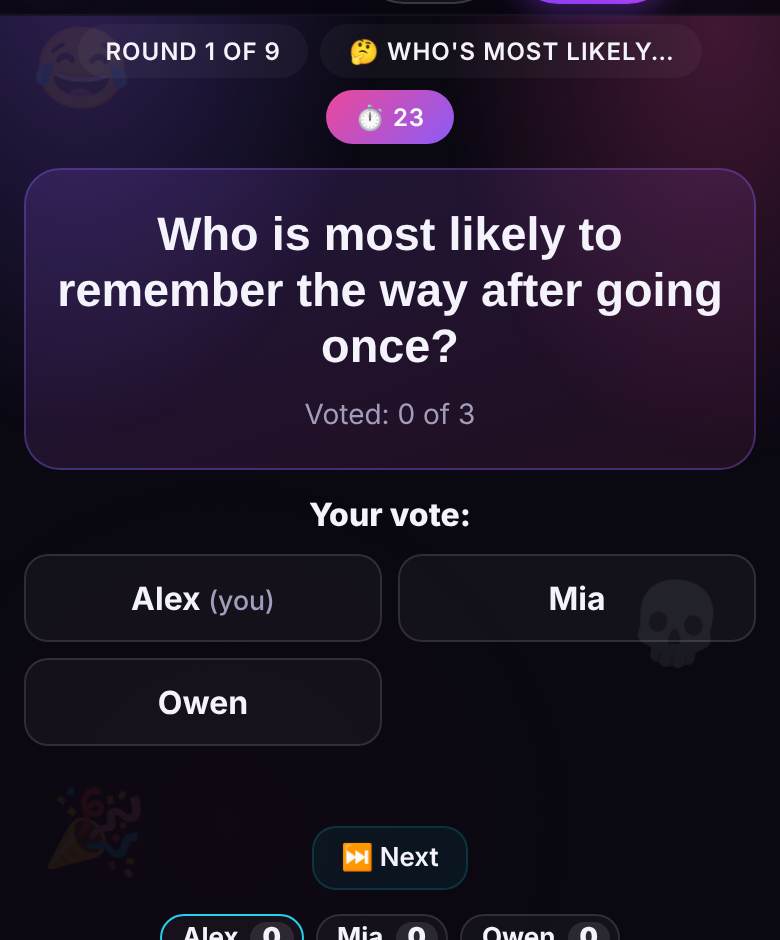
The classic sleepover games, on everyone’s phone
“Who’s most likely to…” and Two truths and a lie are the icebreakers every American knows from camp, college orientation and new-job meetings. Party Box runs both on phones and adds a third: guess the movie, song or saying from a row of emoji. The server counts the secret votes and the TV shows the bars — no keeping score on a napkin.
Each language has its own deck: 167 questions, 134 emoji riddles and 37 ready-made facts. It’s all family-safe, no 18+ mode, so it fits a kids’ birthday, Thanksgiving with grandparents or a team meeting.
How each round works
🙋 Who’s most likely to…
- A question appears, like “Who is most likely to become the unofficial mayor of their street?”
- You have 25 seconds to vote for one player — yourself included. You can change your vote while the timer runs.
- Everyone who voted for the top pick scores 1 point. If two players tie for the most votes, voters for either of them score.
🎭 Two truths and a lie
- The game picks the round’s hero; nobody repeats until everyone has had a turn.
- The hero gets 75 seconds to type two truths and one lie (3 to 120 characters each). The order is shuffled.
- Everyone else has 25 seconds to find the lie: +1 for a correct pick, and the hero earns 1 point for every player fooled.
- If the hero runs out of time, the deck supplies two true facts and one fake, and everybody, hero included, guesses.
🧩 Guess the emoji
- You see the emoji and a category: movie, book or fairy tale, TV cartoon, song, game or saying.
- Type your answer within 40 seconds, up to three tries. The first correct answer scores 3, the second 2, every other correct answer 1.
The checker is forgiving: capitals, punctuation and a leading “The” are ignored, long titles allow a typo or two, and titles in other languages count. One letter off, it says “So close!”. Any phase ends early once everyone has answered.
Playing online: phones as controllers, TV as the stage
The host creates a room and gets a link, a QR code and a four-character room code (letters and digits). Guests open the link in their phone browser, type a nickname and they’re in — no app, no account. You need 3 to 16 real people. No bots: voting on a bot would miss the point.
- Big Screen. The host taps “📺 Open the screen” in the lobby, or opens playparty.live/tv on the TV and enters the code. The TV shows the question, timer, vote bars and reveal — never individual votes, the lie early or the emoji answer.
- No TV? Every phone shows the same stage, so it works on a Zoom or FaceTime call too.
- Pace. The host’s “⏭ Next” button skips a pause. A 9-round game takes about 10 minutes, usually less.
- Finale. A podium plus four awards: Most “most likely”, Master of bluff, Emoji expert and Sharpest guesser. No rating; scores last one game.
- Rematch. Late arrivals join between games and play the rematch. Dropped? Reopen the link on the same phone to get your seat back.
Lobby settings
The host picks the formats (any of the three, at least one) and 6, 9, 12 or 15 rounds. “Who’s most likely to” opens if it’s on, then formats rotate. Questions come in the host’s site language. You can’t add your own prompts, but our “most likely to” questions are ready to read aloud, and the Two truths and a lie guide covers the classic variants. More ideas: TV party games.
Tips that actually win points
- In “most likely to”, vote for who the room will pick, not who you think is right. Matching the majority scores.
- Make your lie boring and your truths weird. “I was on the swim team” fools more people than “I met an astronaut”.
- Prepare your three lines early: miss the 75 seconds and the deck takes over, with no points for fooling anyone.
- In emoji rounds, answer fast: first place pays 3.
- Next up: Bluff Club turns lying into trivia, Meme Party takes up to 10, Explain It! is a team word game for up to 16.