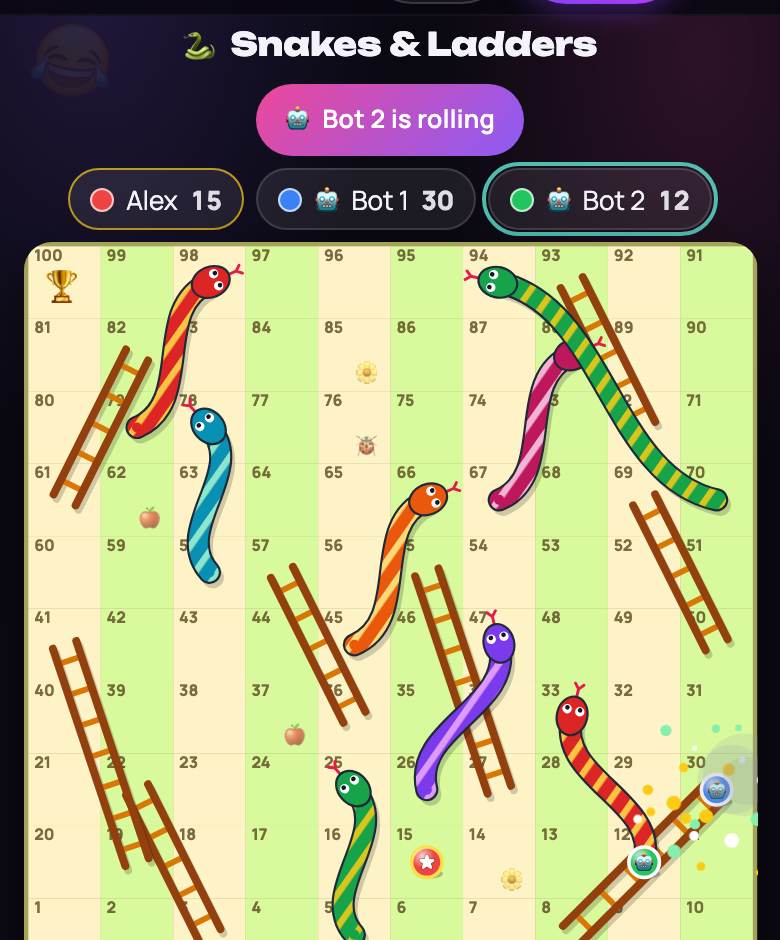
The board game almost everyone played as a kid
Snakes and Ladders needs no introduction: a hundred squares, one die, ladders that shoot you up and snakes that drag you down just when you thought you had it won. It comes from India, where it was played for centuries as Moksha Patam — ladders stood for virtues and snakes for vices. It reached England in the late 1800s and has been a family classic ever since.
Here you can play Snakes and Ladders online with friends, family or bots, right in the browser on a phone or a laptop. Nothing to download, no account: open a room, share the link and start rolling.
Snakes and Ladders rules
- Start. All tokens begin off the board, before square 1. Two to six players, one token each.
- Roll and move. On your turn tap “Roll” or the die and move exactly that many squares, following the zigzag path from 1 to 100.
- Ladders. End your move at the foot of a ladder and you climb straight to its top.
- Snakes. End your move on a snake’s head and you slide down to the tip of its tail. Landing on a tail or the body does nothing.
- Finish. The first player to reach square 100 wins and the game ends right there. Everyone else is ranked by the square they reached.
Tokens can share a square — nobody gets knocked out — which makes it a gentle first game for small kids. There are no tricky decisions; it is all down to the die, so a grandparent, a five-year-old and the most competitive uncle all have the same chance.
Three boards and house rules
Before the game the host picks a board and the rules in the room lobby. Every board is our own artwork, with striped snakes and wooden ladders.
| Board | Ladders | Snakes | Best for |
|---|---|---|---|
| 🌳 Garden | 8 | 8 | the balanced classic |
| 🧸 Little ones | 9 | 5, all short | young kids: lots of climbing, little sliding |
| 🌴 Jungle | 6, very long | 11 | wild swings and comebacks |
The finish can be set the way your family plays it:
- Bounce back from 100 (default): overshoot and you move back by the extra. On 97 with a 5 you touch 100 and bounce to 98.
- Exactly 100: if the roll takes you past the finish, you stay put and wait for the exact number.
- Any overshoot: reaching or passing 100 wins. Shorter games.
- A six rolls again: optional. A six gives another roll, but after a third six in a row the turn moves on.
How to play Snakes and Ladders online with friends
- Type your name, pick “Snakes & Ladders” and create a room. Works on Android, iPhone, tablets and computers.
- Send the link or the room code. Friends join without signing up; up to six fit in a room.
- Short of players? The host adds bots with one tap. One person plus one bot is enough to start.
- Each turn has 20 seconds. If someone drifts off, the die rolls itself so nobody waits; if their connection drops, the game rolls for them and they can rejoin with the same link.
- After the game, “Play again” starts a rematch and the first turn passes to the next player. You can also switch the same room to another game, such as Ludo or Generala.
Is there any strategy, or is it all luck?
Honestly, it is luck: you never choose which token to move or how far to go, so the die decides. That is exactly why it works so well with mixed ages — experience gives nobody an edge and every roll can turn the game around. What the host can shape is the board and the rules.
- Each number comes up one time in six. Four squares from a ladder foot, you have roughly a 17% chance of landing right on it — the same goes for a snake’s head.
- Watch the long snakes near 100. On “Jungle” there are heads on 92, 97 and 99, and with the bounce rule an overshoot can drop you straight onto one.
- “Exactly 100” stretches the ending. From 99 only a 1 will do, so comebacks stay possible until the very last turn. For impatient kids, pick “Any overshoot”.
- The six rule speeds things up. Two rolls in a row make games shorter and livelier; on the third six the turn moves on so nobody hogs the die.
A host tip: with kids of different ages, start on “Little ones” with the six rule on, then switch to “Garden” for the rematch. The youngest gain confidence and the older ones stay interested.
Great for families and classrooms
Snakes and Ladders is ideal for little ones: it practises counting, number recognition up to 100 and waiting your turn. Teachers use it in class and in remote lessons — put the board on the projector, make each team a token and play a ten-minute round. The content is family-friendly, with no required chat and no ads on the board.
If you enjoy dice races, try Ludo online, where tokens do get captured, or Dominoes for older players. More ideas in our guide to board games on your phone.