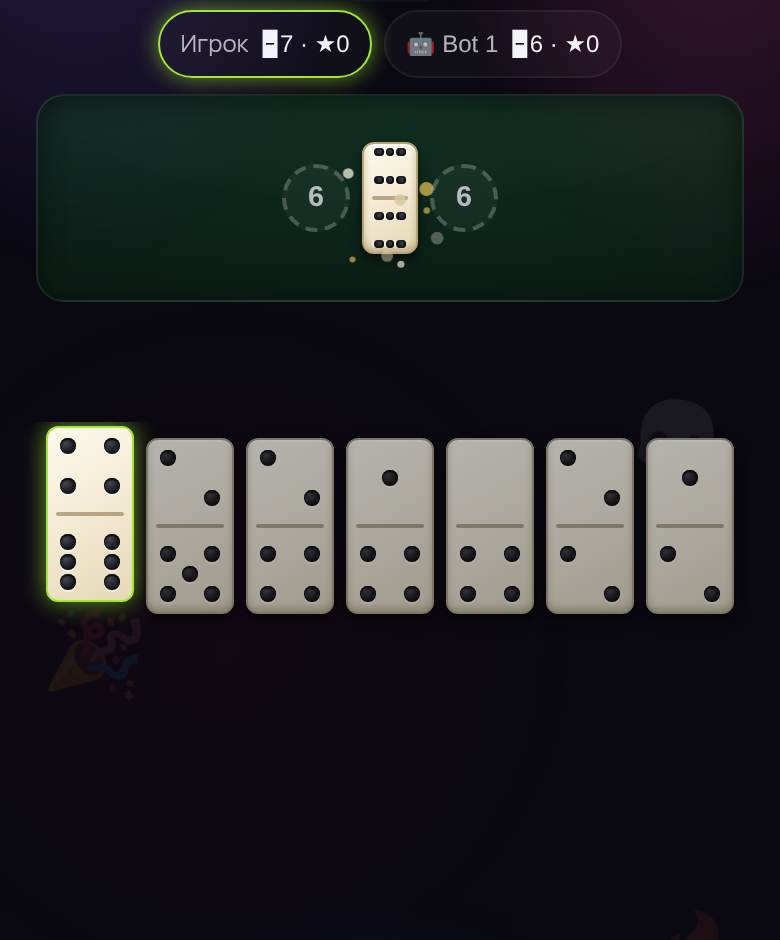
Dominoes: the kitchen-table game, now in your browser
Tile games are centuries old in China; the European set appeared in Italy and France in the 18th century. Most Americans grew up on the 28-tile double-six set — 0-0 (double blank) to 6-6 — and that is the set used here.
The rules take a minute to explain, but memory wins games. Every number from 0 to 6 appears on exactly seven tiles, and the set holds 168 pips. Track what has been played and where opponents passed, and you can often predict their next move.
How our dominoes game works: block rules, no boneyard
- The server shuffles 28 tiles: 7 each for 2 players, 5 each for 3 or 4. The rest (14, 13 or 8) stay face down all round — there is no boneyard to draw from.
- The holder of the highest double goes first (6-6, then 5-5 and so on); if nobody has a double, the heaviest tile decides. The leader may play any tile.
- Take turns matching a number on either open end. One line, two ends — doubles sit crosswise and are not spinners.
- No playable tile? Pass. You cannot pass while you have a legal move: the Pass button only appears when you are truly stuck.
- The first player to empty their hand wins the round.
- If everyone passes in a row, the board is locked and the fewest pips in hand takes the round. A tie for the lowest count is a draw — nobody scores.
- A round win counts as one win, whatever the others still hold. The round winner leads next, and the match runs to the number of wins the host picked.
For a worked example of a full hand and a locked board, read our dominoes rules guide.
Play dominoes online with friends
- Pick Dominoes in the catalog and create a room. You get a link and a 4-character room code (letters and digits).
- Text the link or read out the code. Friends type a nickname and sit down — no account, no app, from a phone, tablet or laptop.
- There are four seats, and the host can fill empty ones with bots: one-on-one with a friend, two friends against two bots, or solo against three.
- The host sets the match length and hits Start.
Each turn has a 30-second clock; if someone stalls or walks away, the server plays their first fitting tile or passes for them. Playable tiles in your hand light up, and when one fits both ends you choose the side. You see each opponent’s tile count and rounds won, and a 🚫 marks who passed. Dropped connection? Reopen the tab to get your seat back.
After the match the host starts a rematch with one tap or switches the same room to another game, such as Ludo or Generala, without a new link. More phone-friendly picks: our guide to board games on a phone.
Settings, and the variants we don’t play
The lobby has one option: how many round wins take the match — 1, 3, 5 or 10, with 3 as the default. A two-player match to three runs about ten minutes. There is no rating and no team mode for dominoes.
- Draw dominoes. Many Americans learned the version where you draw from the boneyard when stuck. Here stuck means pass, so locked boards are more common.
- All Fives / Muggins. We don’t score points when the open ends add up to a multiple of five.
Strategy tips that actually win rounds
- Dump heavy tiles early. 6-6, 6-5 and 5-5 are worth 12, 11 and 10 pips if the board locks.
- Watch the passes. If an opponent passed on a 3 and a 5, they hold neither. Keep putting those numbers on the ends.
- Don’t get stuck with doubles. A double matches only one number, so it is the hardest tile to place. When its number shows up on an end, take the chance.
- Count to seven. If six of the 4s are visible on the table and in your hand, the last is with an opponent or among the face-down tiles (14 with two players) — odds, not certainty.
- Exploit the bots. A bot always plays its heaviest legal tile and ignores your passes. Close both ends on a number it already passed on and it keeps passing.