Dominoes online: block game rules, locked boards and how not to get stuck with doubles
Dominoes is a game for 2–4 players with 28 tiles from 0-0 to 6-6: you take turns matching a tile to an open end of the line, and the first to empty their hand wins the round. If nobody can move, the board is locked and the lowest pip count takes it. Here are the rules, strategy and how to play online.
Which dominoes we play
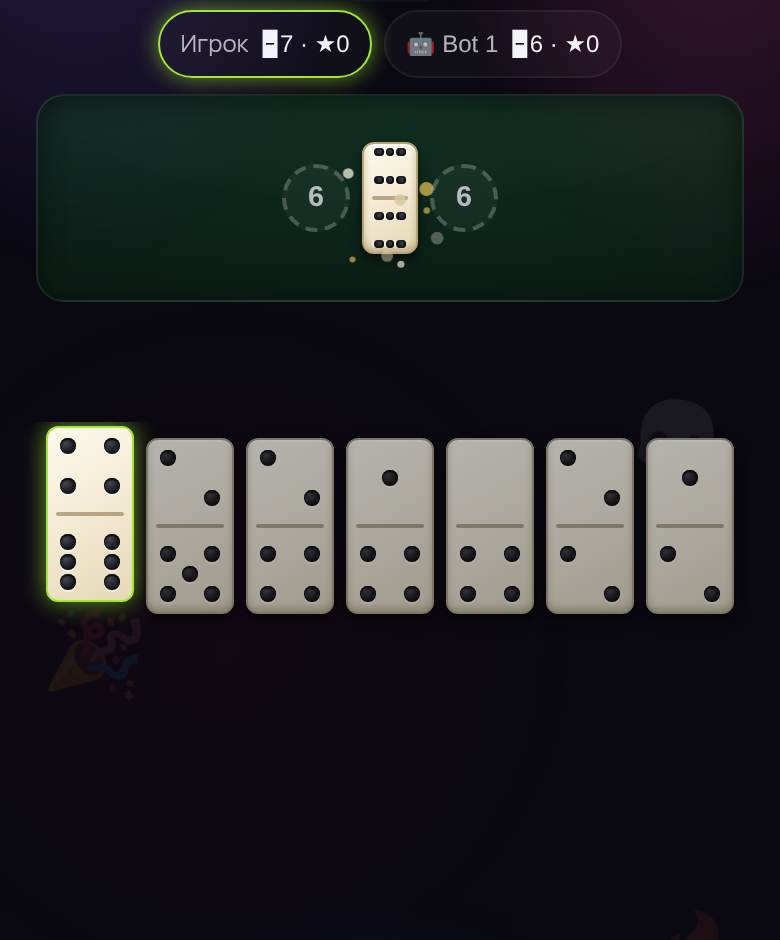
Dominoes is really dozens of games played with one set of tiles. Pub players in England count multiples of five, families across the Caribbean play four-handed partnership games to 100 or 200, and plenty of American households grew up on the draw game, pulling tiles from the boneyard. On playparty.live you get the most basic and fastest version: the block game, every player for themselves, no boneyard — once the tiles are dealt, that is all you get. Learn this one and every other variant will make sense.
The set and the deal
A double-six set has 28 tiles: every combination of the numbers 0 to 6, including seven doubles (0-0, 1-1 … 6-6). Each number appears on exactly seven tiles, which comes in handy once you start counting.
- Two players: 7 tiles each; the remaining 14 stay face down and out of play.
- Three or four players: 5 tiles each; the leftovers are set aside too.
Nobody sees the set-aside tiles, and that is what keeps the game interesting: you never know exactly what your opponent holds.
Who leads and how to play
- The player with the highest double leads: 6-6, or 5-5 if nobody has 6-6, and so on. If nobody has a double, the heaviest tile leads. In later rounds, the winner of the previous round leads.
- Players then take turns adding one tile to either open end of the line. The half you play must match the number on that end: on a 4 end you can play 4-1, 4-6 or 4-4.
- Cannot play? Pass. There is nothing to draw — the block game has no boneyard.
- The round ends when someone plays their last tile, and that player wins it.
A sample two-player round
Ana holds 6-6, 6-2, 5-3, 4-1, 2-2, 3-0 and 1-1. Ben holds 5-5, 6-4, 4-4, 2-1, 3-3, 5-0 and 6-1. Ana has the highest double, so she leads 6-6. Ben plays 6-4, leaving open ends of 6 and 4. Ana plays 4-1 on the 4, so the ends are 6 and 1. Ben answers 6-1 on the 6: ends 1 and 1. Ana drops her 1-1 double, Ben plays 2-1, and the ends are 1 and 2. Ana plays 2-2, Ben has no more 2s and passes — so Ana now knows he holds no 2s.
From there it is all about attention: Ana keeps numbers Ben lacks on the ends and saves a tile to answer his move. If both pass at some point, hands are counted — and whoever shed their heavy tiles in time takes the locked round.
Locked board: when nobody can move
Sometimes both ends of the line show numbers nobody has left. Everyone passes in a row — the board is locked. Players reveal their hands and add up the pips on the tiles they still hold: the lowest total wins the round. A tie means the round is a draw. Hence the first rule of block dominoes: heavy tiles in your hand are a liability.
How a match is scored
Each round you win is worth one point, and by default a match goes to five round wins; in the lobby you can switch it to one, three or ten. A match to three takes about ten minutes, perfect for a break. Each turn has a 30-second clock: if a player stalls or walks away, the server plays for them so the game never hangs.
Beginner strategy
- Dump heavy tiles early. 6-6, 6-5 and 5-5 are 12, 11 and 10 pips if the board locks. When a move is otherwise neutral, get rid of the heavy one.
- Keep variety. A hand full of the same one or two numbers runs into a pass quickly. Try to hold tiles with different numbers so you can answer any end.
- Remember what your opponent passes on. If they passed on a 3, they have no 3s. Keep 3s showing on the ends and they will keep passing.
- Count what has been played. Each number lives on seven tiles. If five tiles with a 5 are on the table and you hold the other two, that 5 end belongs to you alone.
- Doubles are not treasure. A double only fits one number, so it gets stuck in your hand more often. Play doubles when the chance appears.
Other domino games worth knowing
- Draw dominoes. Cannot play? Draw from the boneyard until you can. Rounds run longer and locked boards are rarer.
- All Fives (Muggins). You score whenever the open ends add up to a multiple of five — great for quick mental math.
- Partnership dominoes. Four players, partners sit across from each other, points pile up to 100 or more. The Caribbean classic.
- Mexican Train. A big set up to 12-12, everyone builds their own train from a central hub. More family board game than quick match.
How to play dominoes online with friends
- Open dominoes on playparty.live and create a room — no account, just a name.
- Drop the link or the 4-character code into your group chat. Friends join from a phone or computer with nothing to install.
- Short on players? Add bots. They greedily dump their heaviest tiles — a decent sparring partner while you learn.
Dominoes pairs perfectly with conversation: hands busy, mind free. That is why it is a favorite on family video calls and lunch breaks. Want another four-player classic? Try Ludo, the token race where dice and nerves decide everything. More board games in our post on board games on your phone.
FAQ
Can we play in partnerships?
Not yet — everyone plays for themselves. A team mode is a frequent request from Caribbean and Latin American players, and we hear it.
Why can’t I draw a tile?
Because this is the block game: with no boneyard every move matters more and rounds are shorter. In the draw game you pull tiles until you find one that fits.
How long does a game take?
A round takes 2–4 minutes. A match to five round wins (the default) takes 15–20 minutes; to three, about ten.
Can two people play?
Yes: with two players each gets 7 tiles. For more two-player games, see backgammon with a friend online.
🁢 Play Dominoes right now
Against a bot, no sign-up — your first game in a couple of minutes
More about Dominoes · Browse all 34 games · Online party games with friends