How to host a trivia night at work: teams, timing, good questions and a quiz board on the TV
Trivia is the safest act at any office party: finance, engineering and the new hire who started on Monday all feel equally at home. Here is how to run a 40–60 minute trivia night: formats, team sizes, timing, how to write questions, a ready holiday round with answers, scoring and a remote version. The board goes on the TV; everyone answers from their own phone.
Pick a trivia format
Office trivia comes in three main flavors, and the right one depends on how much prep time you have.
- Themed rounds. The host reads ten questions, teams write answers on paper, then everyone swaps and marks. The classic pub-quiz format, but lots of paper and slow scoring.
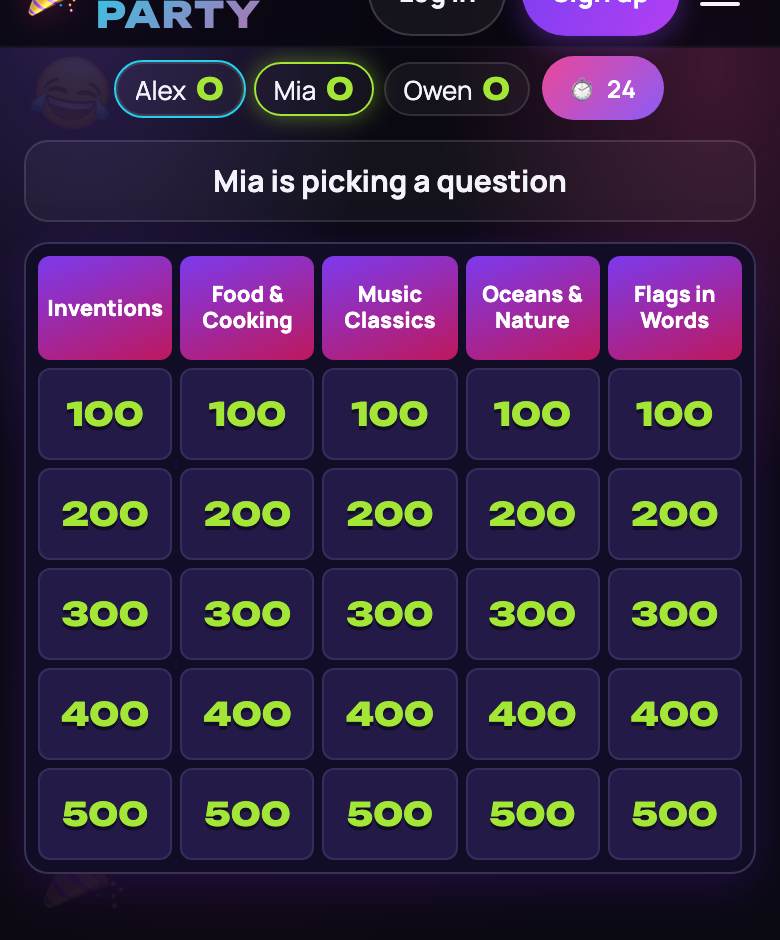
- A board of categories and point values. The screen shows a grid: five categories, five questions each, worth 100 to 500. A team picks a cell, and whoever buzzes first answers — a format similar to a well-known TV quiz with a board of categories.
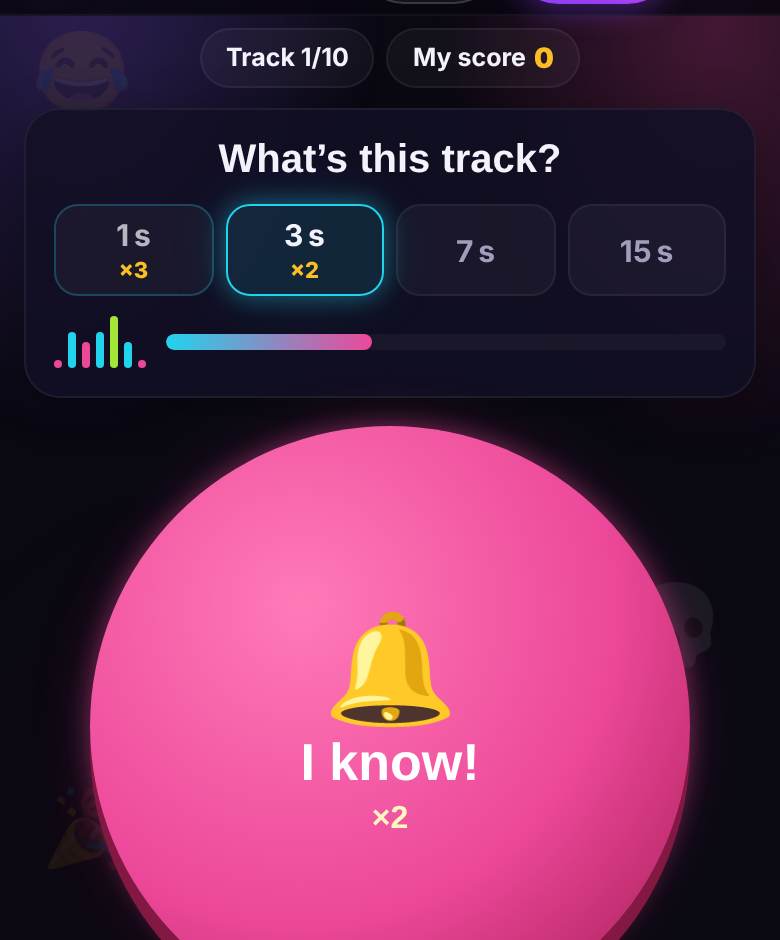
- A music round. Naming a song from its first seconds is the fastest way to wake up a room. It slots nicely between board rounds.
For a work event the board wins: everyone gets the rules in a minute, teams pick categories they are strong in, and the score is always on screen. That is how our online trivia board works: the TV shows the grid and the question, and every phone shows four answer options and a big “I know!” button.
How the quiz board works, in one minute
- A team (or player) picks a cell: a category and a value.
- The question and four options appear on the TV and every phone. While it is being read, the buzzer is closed — press too early and you get a short lockout.
- The first to hit “I know!” picks an option. Right: plus the cell value, and that side picks next. Wrong: minus the value, that side is out for this question, and everyone else can buzz again.
- In round two every value doubles, and the trailing side picks first.
- Final: every side with a positive score sees the category, bets in secret and answers in secret. All answers are revealed together.
Each round hides two special cells. Stake: whoever finds it bets points — from the round’s lowest value up to their score (or up to the round’s top value if their score is lower) — and answers alone. Pass it on: the question must go to another team, and they answer it. Nobody knows where they are until they are opened, which is exactly why people scream.
Play solo or in 2 to 4 teams, with 2 to 12 players on phones. The host can play or just present: in presenter mode their phone becomes a remote and they are not on the scoreboard.
Team sizes and timing
| Group size | Setup | Sides on the board | Time |
|---|---|---|---|
| 2–6 | Solo, everyone on their own phone | 2–6 | 30–40 min |
| 6–12 | 2–4 teams, every member can buzz | 2–4 | 40–50 min |
| 12–40 | Solo mode, but one phone per table | up to 12 | 45–60 min |
| 40+ | Two or three games in parallel rooms, then a winners’ final | up to 12 each | 60–75 min |
A round is 25 questions. With reading, buzzing and the reveal, it takes 15 to 20 minutes; two rounds plus the final run about 45 minutes. Tight agenda? Switch to a single round in the settings.
How to write good trivia questions
Built-in boards come in four languages: the English set has about 27 categories, from Space and Classic Movies to Words & Idioms, drawn at random each game. But the best trivia for work uses your own questions. In the board editor you can build 1 or 2 rounds of 1 to 6 categories with up to 5 questions each. Every question needs one right answer and three wrong ones. Your draft stays in your browser, and you can export the finished board as a file and load it again next year.
| Value | Difficulty | Example |
|---|---|---|
| 100 | Everybody knows | Who painted the Mona Lisa? |
| 200 | Most people know | Which planet is closest to the Sun? |
| 300 | Needs a moment | What is the capital of Australia? |
| 400 | Someone on the team knows | Which is the only US state with a one-syllable name? |
| 500 | Hard but fair | Which element has the symbol W? |
- Make the wrong options believable. For Canberra, offer Sydney, Melbourne and Perth, not Paris. Good decoys are what make a question fun.
- One question, one fact. Two lines max — nobody reads a paragraph before the buzzer opens.
- No arguable answers. “The most popular movie” starts a fight; “the highest-grossing movie” is a fact.
- Questions about coworkers stay kind. “Whose baby photo is this?” is great. Salaries, layoffs and dating are off limits.
Sample trivia questions with answers
| Category | Value | Question | Answer |
|---|---|---|---|
| Holidays | 100 | What do kids in the US traditionally leave out for Santa? | Milk and cookies |
| Holidays | 200 | How many nights does Hanukkah last? | Eight |
| Holidays | 300 | Which country sends a Christmas tree to Trafalgar Square every year? | Norway |
| Holidays | 400 | Which Scottish poet wrote the words of “Auld Lang Syne”? | Robert Burns |
| Holidays | 500 | In what year did the first New Year’s Eve ball drop in Times Square? | 1907 |
| Movies | 200 | In “Home Alone,” where is the family flying when they leave Kevin behind? | Paris |
| Movies | 300 | In “Elf,” what is the first of Buddy’s four main food groups? | Candy |
| Art | 100 | Who painted the Mona Lisa? | Leonardo da Vinci |
| Science | 200 | Which planet is closest to the Sun? | Mercury |
| Geography | 300 | What is the capital of Australia? | Canberra |
| Geography | 400 | Which is the only US state with a one-syllable name? | Maine |
| Science | 500 | Which element has the chemical symbol W? | Tungsten |
An “About us” category takes half an hour with HR: “What year did we open our first office?”, “How many cups of coffee does the team drink a week?”, “Whose desk is this?” (photo, no people). Put it in round two, once people have warmed up. And a guess-the-song round built from the team’s playlist of the year makes a great break between board rounds — see our guide to hosting a guess-the-song game.
Scoring, tie-breaks and prizes
- Losing points for a wrong answer is fair. Without a penalty, everyone mashes the buzzer. With one, teams think first.
- The final decides it. Sides with a positive score go to the final. A leader can bet zero to protect the lead; teams behind can bet everything.
- Ties. Keep a closest-number question in your pocket: “How tall is the Statue of Liberty from ground to torch, in feet?” Closest wins (305 ft).
- Prize more than first place. “Boldest bet,” “Best team name,” “Fastest finger” — joke awards beat a gift card.
Virtual and hybrid trivia for work
For a remote team the setup is the same; the board is just screen-shared on the call. The host opens a room, posts the link or 4-character code in chat, opens playparty.live/tv on their laptop and shares that tab. Everyone answers on their phone, so video lag does not matter: the server decides who buzzed first, not whoever the host happened to hear first. Hybrid works the same way — the office watches the TV, remote people watch the shared screen, and everyone plays on one board. For more ideas, see our games for video calls and the full office party games plan.
Mistakes that sink a trivia night
- Questions that are too hard. If nobody gets the 100s, you lose the room in five minutes.
- A loud room and no mic. The board is readable, but the host needs a microphone or the jokes die.
- Forming teams on the spot. Assign teams in advance instead of counting off in front of everyone.
- A host who writes the questions and plays. If you wrote the board, switch on presenter mode: your phone is a remote and you are off the scoreboard.
- Trivia as the last act. After dinner and dancing nobody is paying attention. The sweet spot is 30–40 minutes into the event.
FAQ
How do I host a trivia night at work for free?
Open the trivia board in a browser, put it on the TV, and coworkers join by link or code from their phones. No sign-up; built-in questions are ready and you can add your own.
How many questions should a work trivia night have?
Two rounds of 25 questions plus a final take 45–50 minutes. If the evening has other acts, one round is plenty.
Can I make a trivia game with my own questions?
Yes. In the board editor you set categories, questions and four answer options each. The draft is saved in your browser and you can export the board as a file to reuse.
How does virtual trivia for work handle video lag?
Players buzz on their own phones and the server records who was first, so a delayed video feed does not change the result.
How many people can play?
Up to 12 phones per game, solo or in 2–4 teams. For a large room, use one phone per table or run several games in parallel.
🟦 Play Quiz Board right now
Needs 2+ players — friends join by link or QR
More about Quiz Board · Browse all 34 games · Online party games with friends