What OCHO! is and where it comes from
OCHO! is our take on crazy eights, the card-shedding game American families have played since the 1930s. The original uses a standard 52-card deck: match the suit or rank on top, and any eight is wild. Our name is Spanish for “eight,” a nod to that card.
Later versions added action cards and colored decks — if you grew up on Uno, it will feel familiar. OCHO! is our own game, with its own modes and house rules, and it runs entirely in your browser.
OCHO! rules in six steps
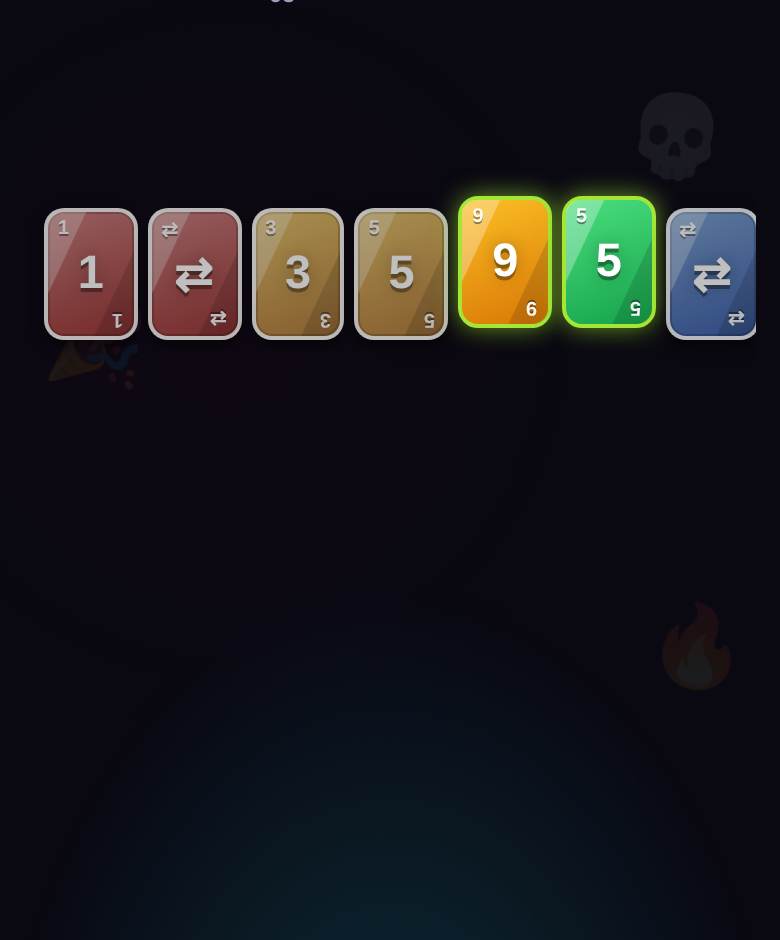
- The deck has 108 cards in four colors: each color has one 0, two each of 1–9, and two each of Skip, Reverse and +2. Add 4 wild cards and 4 wild +4s. Everyone gets 7 cards, and the first card flipped is always a number.
- On your turn, play a card that matches the top card’s color or symbol. A wild goes on anything and you pick the next color. The wild +4 is legal any time — there is no challenge rule.
- Can’t play, or don’t want to? Draw one card. If it fits, play it or pass (you get 15 seconds to decide); if not, the turn moves on.
- Skip takes away the next player’s turn, Reverse flips the direction (in a two-player game it works like a Skip), and +2 or +4 makes the next player draw and lose their turn. In Classic, penalties don’t stack.
- Down to two cards? Hit the OCHO! button. Anyone left with one card who hasn’t called can be caught by any opponent with the Catch! button — two penalty cards.
- The first player to empty their hand wins the round and scores a point; the match goes to a set number of round wins. If the deck runs dry, the discard pile is reshuffled except for the top card.
History and variants: our crazy eights rules guide.
How to play online with friends
Create a room to get a link and a four-character code (letters and digits). Text it to the group chat; friends open it on a phone or laptop, type a nickname and they’re in. No account, no download.
A room holds 2 to 8 players. Short on people? The host taps “🤖 Bot” to fill seats, or you play solo against bots. Each turn has a 30-second clock; run out and the game plays for you, even calling OCHO! at two cards. The first turn rotates every round, and the host can start a rematch in the same room.
Modes and house rules
Before starting, the host picks how many round wins take the match — 1, 3, 5 or 10 (default 5) — and one of three modes:
- Classic — the base rules; switch house rules on one at a time.
- Caos — stacking, 7-0 and jump-in are always on.
- 2v2 — two teams of two, partners sitting opposite. The team whose player goes out first takes the round. Needs exactly 4 players; you can’t see or catch your partner.
House-rule toggles: Draw until playable (keep drawing until something fits); Stack +2/+4 (answer a +2 with a +2 or +4, a +4 only with a +4 — whoever can’t answer takes the whole pile-up); 7-0 (a 7 swaps your hand with a player you pick, a 0 passes every hand along the direction of play); Jump-in (slap down an exact copy of the top card out of turn); and the OCHO! penalty, on by default — turn it off and nobody can be caught.
Strategy tips
- Save the +4 for the endgame. Against someone holding two cards it sends them back to six.
- Call early. You can hit OCHO! with two cards left, and the call sticks when you play the next one. Drawing from the deck afterwards clears it.
- Catch on their turn, not yours. The Catch! button works any time, and bots forget to call roughly one time in four.
- Track colors people draw on. Drew twice on yellow? They have no yellow — steer back to it.
- Card values don’t matter. Leftover cards aren’t scored, so dump awkward cards and keep one of each color.
Want more cards? Try Hearts or the Russian classic Durak; Dominoes is shedding with tiles. More: games you share by link, no sign-up.