Crazy eights, Mau-Mau and the whole card-shedding family
One rule — play a card matching the colour or the value on top — grew into a whole family of games, from German Mau-Mau to Dutch Pesten. Here is how it works and where the actual skill hides.
One mechanic, a dozen names
Americans in the 1930s played Eights, where the eight was a wild card that switched the suit. By the 1950s it had picked up the nickname crazy eights and crossed the Atlantic: Mau-Mau in Germany, Pesten in the Netherlands, Switch in Britain, ocho loco in Latin America. Same spine everywhere — shed your hand fastest and ruin your neighbour's turn on the way.
Later the family swapped suits for coloured decks, and the rules became familiar to anyone who has played a UNO-style game. The mechanic underneath is ninety years old, and any 108-card four-colour deck runs on it.
The basic shedding rule
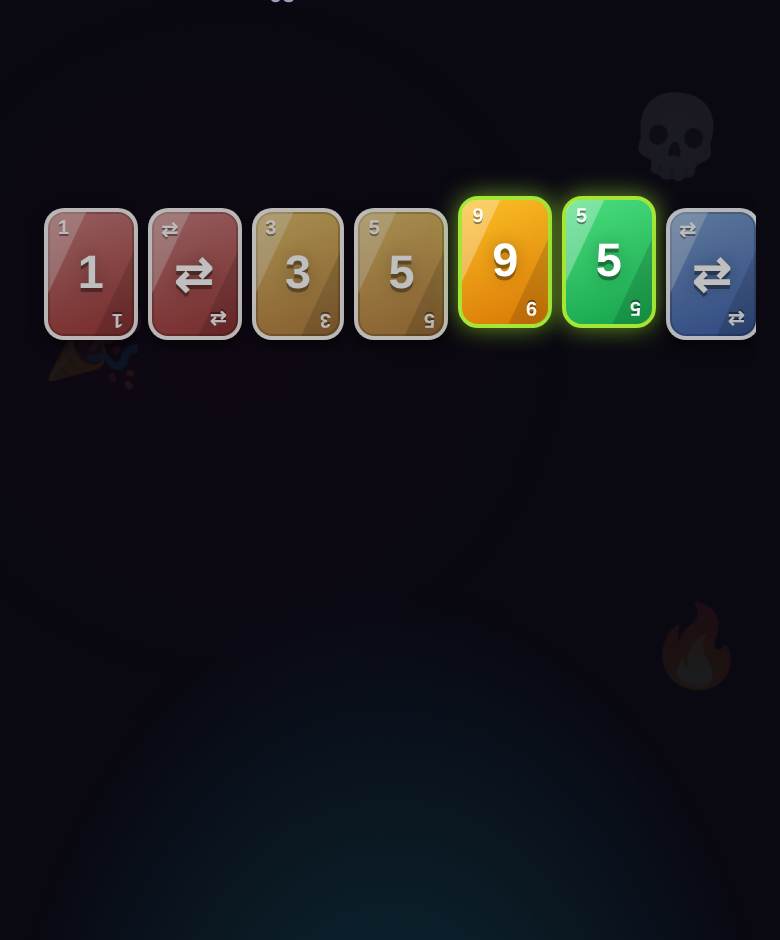
The deck holds 108 cards in four colours. Each colour has one zero, two of every value from one to nine, and two of each special: skip, reverse and draw-two. Add four colour-change cards and four colour-change draw-fours. Seven cards each, and the opening discard is always a number.
On your turn you play a card matching the top one by colour or by value. A red seven goes on a red three and on a blue seven. Colour-change cards go on anything. Nothing playable? Draw one: if it fits you may play it or pass, and if not, the turn moves on.
What the special cards do
- Skip — the next player loses their turn.
- Reverse — play switches direction. Two-handed it works as a skip, so the turn comes straight back to you.
- Draw two — your neighbour takes two cards and loses the turn. Penalties do not stack: you cannot answer with your own draw-two and push six cards along.
- Colour change — playable on anything, and you name the new colour.
- Colour change plus four — the same, plus the next player draws four and misses a turn. No challenge rule, so it is legal whenever you like.
When the deck runs out, the discard pile is reshuffled apart from its top card. A long round never grinds to a halt.
The shout on your second-to-last card
The moment you are down to two cards, hit the OCHO! button. Play your second-to-last card in silence and any opponent can catch you — two penalty cards straight into your hand. Only a player holding exactly one card who has not called can be caught.
The trick is timing. You may call at two cards and it sticks when you play the next one; the players waiting for a perfect moment are the ones who get caught. One wrinkle: drawing from the deck clears your flag.
How winning is scored
The first player to empty their hand takes the round and scores a point. The match runs to a set number of round wins — five by default, and the host can switch it to one, three or ten in the room settings. Card values in the losers' hands never count: a nine is no worse than a two, and only card count and colour coverage matter.
Six decisions that win rounds
- Save the draw-four for the endgame. Against an opponent holding two cards it sets them back six; played on turn three it buys one tempo and nothing else.
- Track who draws on which colour. An opponent who drew twice while yellow was live has no yellow — steer the game back to yellow whenever you can.
- Watch hand sizes, not your own hand. Skips and draw-twos belong on the player sitting at two or three cards, not the one nursing eight.
- Do not spend your last card of the current colour. One lonely blue while blue is live is an escape hatch; play it early and you start drawing.
- Matching values are a chain. Two sevens in different colours let you swing into either colour and play twice in one lap of the table.
- Catch the quiet ones. The button works outside your turn, and bots forget to call about a quarter of the time. Two penalty cards decide plenty of rounds.
Two players versus eight
Heads-up, reverse and skip both hand you two turns in a row, and a pair of specials often ends a round on the spot — hoarding them is almost always right. Eight-handed, your draw-two comes back seven turns later, when everything has changed. There, colour coverage wins: one card of every colour beats a stockpile of weapons.
OCHO! on playparty.live
OCHO! seats 2 to 8 players, runs on a phone and needs no install and no account. Open a room, send the four-letter code, friends join by link. Turns are 30 seconds, decisions on a drawn card 15; run out of time and the engine plays for you and calls at two cards.
No group tonight? Add bots — brisk, they catch you when you stay quiet, and they forget to call often enough to punish. Five free minutes is exactly one round, which is the idea behind our games for a coffee break. For something slower and meaner, try Durak or the no-signup games you share by link.
🎴 Play OCHO! right now
10 seconds from click to game. No sign-up, nothing to install.
Play free now