The game that became Werewolf
Mafia was invented in 1986 by Dmitry Davidoff at Moscow State University’s psychology department: an informed minority against an uninformed majority. It spread from Soviet dorms to American campuses, and in 1997 Andrew Plotkin reskinned it as Werewolf.
At a real party someone has to sit out as moderator. Here the game deals roles, runs night and day and counts votes, while an AI host narrates — so everyone plays.
How a game runs here
- Everyone gets a secret role: Mafia, Mafia Don, Doctor, Sheriff (your group may say Cop or Detective) or Citizen. Mafia members see each other.
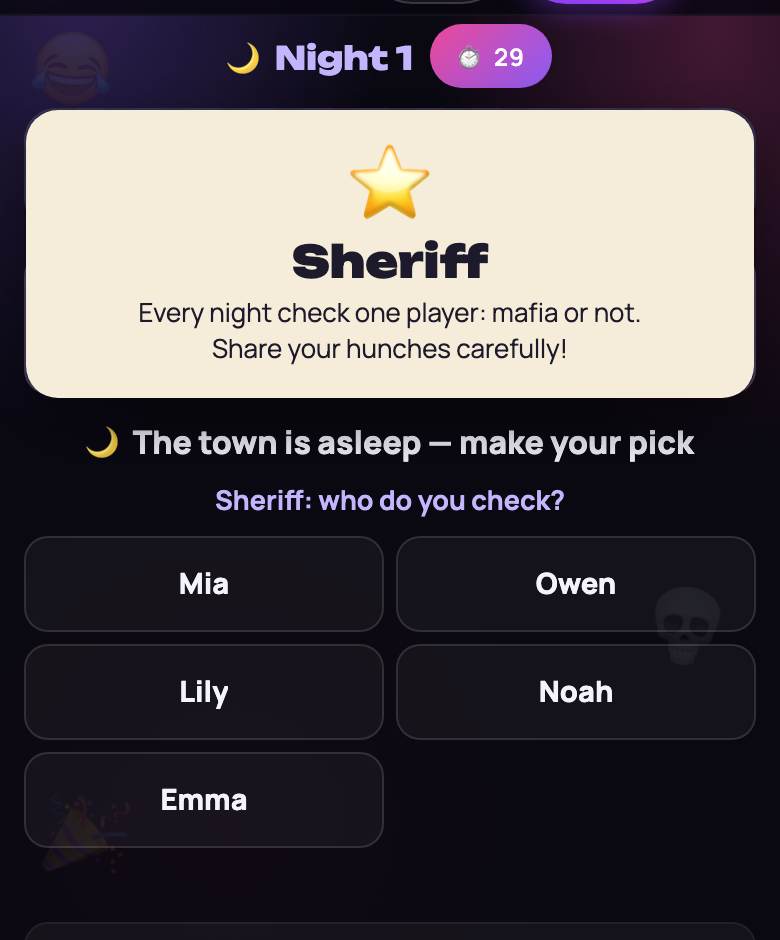
- Night. The mafia picks who leaves and sees each other’s picks. The Doctor protects one player — self included, never the same person two nights running. The Sheriff checks one player: “mafia” or “not mafia.” The Don reads as “not mafia.”
- Morning. The host says who left, that someone was saved (no name) or that the night was quiet.
- Day. A timed discussion; each player may nominate one suspect.
- Vote among nominees, or anyone alive if nobody was nominated. You can abstain but not vote for yourself. A player leaves only with more votes than every rival and than the abstentions. A tie at the top triggers a revote between the leaders; a second tie means nobody leaves.
- The town wins when the mafia is gone; the mafia wins once it equals the town. Eliminated players watch but don’t vote.
| Players | Mafia (one is the Don) | Doctor & Sheriff | Citizens |
|---|---|---|---|
| 6–8 | 2 | one each | 2–4 |
| 9–12 | 3 | one each | 4–7 |
| 13–15 | 4 | one each | 7–9 |
| 16 | 5 | one each | 9 |
Role details and house-rule debates are in our guide to Mafia rules.
Play Mafia online free with friends
Create a room to get a link and a 4-character code (letters and digits). Friends open it on a phone or laptop and type a nickname — no account, no app.
- 6 to 16 real people. No bots — bluffing a computer is no fun — so it won’t start with five.
- Hold to peek. Your role shows only while your finger is on the card. Tap “Got it”; after 25 seconds night starts anyway.
- Same screen at night. Citizens also see “The town is asleep” and mark a suspect. It changes nothing, but nobody can spot roles by who’s tapping.
- Timers. Night lasts up to a minute and ends early once the mafia agrees and the Doctor and Sheriff have acted. Votes take 45 seconds, revotes 30. The room creator can hit ⏭ to end the discussion or skip narration, never the night.
- Big screen. Open playparty.live/tv on a TV or laptop and enter the code: phase, timer, the story in large type, who has voted and the tally — no living player’s role until the end. 🔈 reads it aloud.
- Reconnects. Reopen the same link and your role comes back. Anyone offline over 15 seconds loses their night action. Results reveal every role; rematch is one tap.
What the AI host knows
At nightfall, each morning, after votes and at the finale, the host speaks one to three sentences in your chosen setting. It gets only public facts — night number, who left, vote count, players remaining — never roles, night picks or checks, so it can’t leak. The tone is family-friendly: people “leave town.” If the AI takes over 7 seconds or is off, a prewritten line plays.
Lobby options
- Don, Doctor, Sheriff — each can be turned off; the slot becomes a Citizen.
- Day discussion — 2, 3 (default) or 5 minutes.
- Reveal the role of who leaves — off by default, so the town never learns if it voted right. Turn it on for beginners.
- Mafia tie at night — nobody leaves (default) or a random pick.
- Story theme — town, pirate ship, space station or castle; the AI host can be switched off.
Strategy that helps
- Count to parity. Six players means two mafia. Lose a citizen at night and another by vote and it’s 2 vs 2 — instant mafia win. In small games, abstaining beats guessing.
- Sheriff: “not mafia” isn’t proof. The Don looks the same. Go public once you’ve caught someone.
- Mafia: agree fast. Split picks drag the night, and an even split means nobody leaves.
- Watch nominations. Everyone sees who nominated whom: a better clue than any speech.
More bluffing: Bluff Club. Team play: Cipher Words and Explain It!. TV setup tips: party games on a TV with phones.