An American puzzle with a Japanese name, now a race
Sudoku started life in 1979 as “Number Place” in Dell puzzle magazines, picked up its Japanese name from the publisher Nikoli in the 1980s, and exploded worldwide after British newspapers ran it in 2004. The rule fits in one line: fill the 9×9 grid with 1–9 so no digit repeats in a row, column or 3×3 box. Sudoku Duel turns that solo habit into a race: everyone in the room gets the identical grid and solves it at the same time.
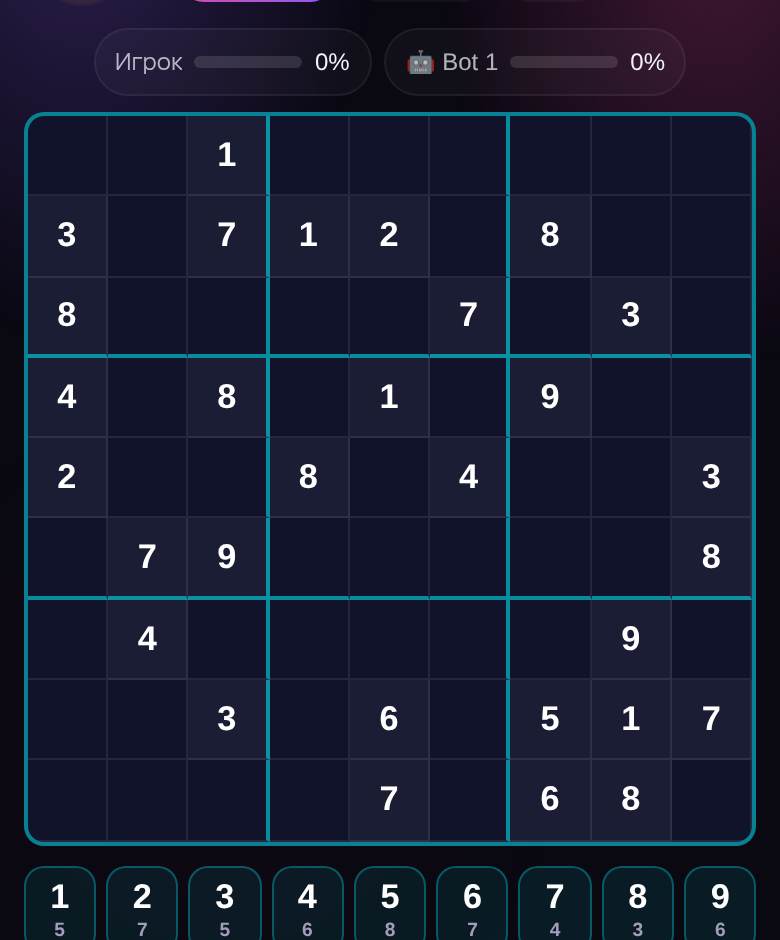
You never see an opponent’s digits — only a live progress bar showing what percent of the empty cells they have filled correctly. Nobody can copy, but watching a friend jump to 70% while you sit at 40% is pressure enough.
How our multiplayer sudoku works
- The host picks a difficulty; everyone receives the same puzzle, which always has exactly one solution.
- Select a cell and tap a digit. The server checks it instantly: a correct digit locks in and can no longer be erased; a wrong one turns red and your ✗ mistake counter goes up.
- Erase a wrong digit and try again. Mistakes do not subtract points — they only cost you time.
- Each player has three hints per game. A hint reveals the correct digit in the selected cell, but that cell earns no points.
- The first player to fill the whole grid correctly wins, and the game ends for everyone on the spot.
- If the clock runs out first, the player with the most correct cells wins.
Difficulty and clock
| Level | Given digits | Time limit |
|---|---|---|
| Easy | ≈38 | 6 min |
| Medium | ≈30 | 10 min |
| Hard | ≈26 | 14 min |
| Expert | ≈23 | 18 min |
Givens are approximate: a digit is removed only if the solution stays unique.
Scoring
Every correct cell you enter yourself is worth 1 point; a hinted cell is worth 0. Completing the grid adds +5, and winning the game (first correct finish, or best board when time expires) adds +10 more. Losers keep the points for their own cells, so it always pays to keep solving.
Play sudoku with friends online
Tap Create, type a nickname, and your room is live. Text the link to a friend or read out the four-character room code (letters and digits); they open the site on a phone or laptop, pick a nickname and land in the lobby. No account, no app download.
- Solo. One player is enough: start the game alone and beat the clock. Results go into your history and the site-wide leaderboard.
- Head-to-head or a group. Two people make the classic duel, but a room holds up to 10 players on the same grid.
- Humans only. There are no bots in sudoku — the “add bot” option does not apply here.
- No pause. The clock is shared. The host can end a game early and start a rematch with a fresh grid afterward.
- Same room, next game. From the lobby the host can switch the room to Nonogram or another title without sending a new link.
Board features
Toggle ✏️ Notes to pencil in small candidate digits; when you place a correct number it is wiped from the notes in its row, column and box automatically. The selected cell highlights its row, column, box and every matching digit. The number pad shows how many of each digit are still missing and marks a finished digit with ✓. On a keyboard use 1–9, the arrow keys, Backspace, and N for notes.
Speed tips for a sudoku race
- Open with digits that have only one or two left on the pad — their spots usually jump out without any notes.
- Cross-hatch by bands: if a digit already sits in two boxes of a three-box band, it has one row left in the third box, often one cell.
- Skip notes on Easy; on Hard and Expert, pencil candidates only in cells with two or three options.
- A wrong guess costs seconds, not points. With two candidates and the clock ticking, testing one is a legitimate move; with five, it is a coin toss.
- Save hints for the endgame. A hinted cell scores nothing, but it can fill your last stubborn cell — and that counts as a finish.
More ideas for a short break: 5-minute games for work or school. For another brain duel, try Chess or Tic-Tac-Toe.